
TBE in the Czech Republic
Petr Pazdiora
E-CDC risk status: endemic
(last edited in June 2026, update for 2024: 680 cases; update for 2025: 730 reported cases)
History and current situation
The TBE virus (TBEV) was first isolated in the Czech Republic by a Czech scientist in 1948-1949 from both a patient and also from Ixodes ricinus ticks.1
However, even before 1948, etiologically unclear summer cases of viral meningoencephalitis had been reported, and likely, at least in part, they are attributable to the TBEV. These cases were reported mostly from patients in the districts of Beroun (Central Bohemia), Hradec Králové (East Bohemia), Vyškov (South Moravia), and occasionally from the neighborhood of Prague. The official reports of these probable cases of “tick-borne encephalitis” were registered in the database of the National Institute of Public Health in Prague since 1945.
The first TBEV isolation was accomplished from blood and cerebrospinal fluid of a patient with meningoencephalitis. Other successful isolations were from subjects with a history of a tick bite. The first successful attempt of isolation of the TBEV from different developmental stages of I. ricinus ticks collected in forests of the district Beroun was in 1949. The analysis of an outbreak of meningoencephalitis in Rožňava in south-eastern Slovakia in 1951 from Czech and Slovak specialists ended with the discovery of the alimentary transmission of the TBEV.
The definition of TBE for reporting changed in the following decades. Following a ministerial decree from 1970, only clinically-manifested, laboratory-confirmed cases of TBE were to be reported to the central surveillance center. The number of case characteristics collected from TBE patients has gradually increased ever since 1982. Since 1993, the national reporting system (EPIDAT) has been computerized. TBE surveillance was established by Regulation No. 275/2010, Annex No. 28.
The Czech Republic is a highly TBE endemic country. Many cases are associated with outdoor activities (camping, living in secondary residences in the countryside, hiking, hunting, fishing, mushrooming), while the incidence of possible occupational transmission has decreased over the last years (in 2007-2023 289 cases, i.e. 2.7% among foresters, and farmers mostly). Numbers of imported cases from abroad are very low with only 5 cases (0.7%) in 2022, and 12 cases (2.3%) in 2023. The geographical distribution of TBE is changing. The gradual spread of TBE into formerly unaffected districts, namely into the border districts of the country at higher altitudes is highlighted. Long-term observations confirm a shift of age-specific incidence rates to older age groups. The period of the transmission of TBE is changing, too. The “TBE-season” with detection of cases is longer than 30-50 years ago and lasts from March to December. These changes of basic epidemiological characteristics may be due to climatic changes, changes of environmental and/or other factors. These factors are affecting the different interactions between TBEV, its vectors and vertebrate hosts, too.
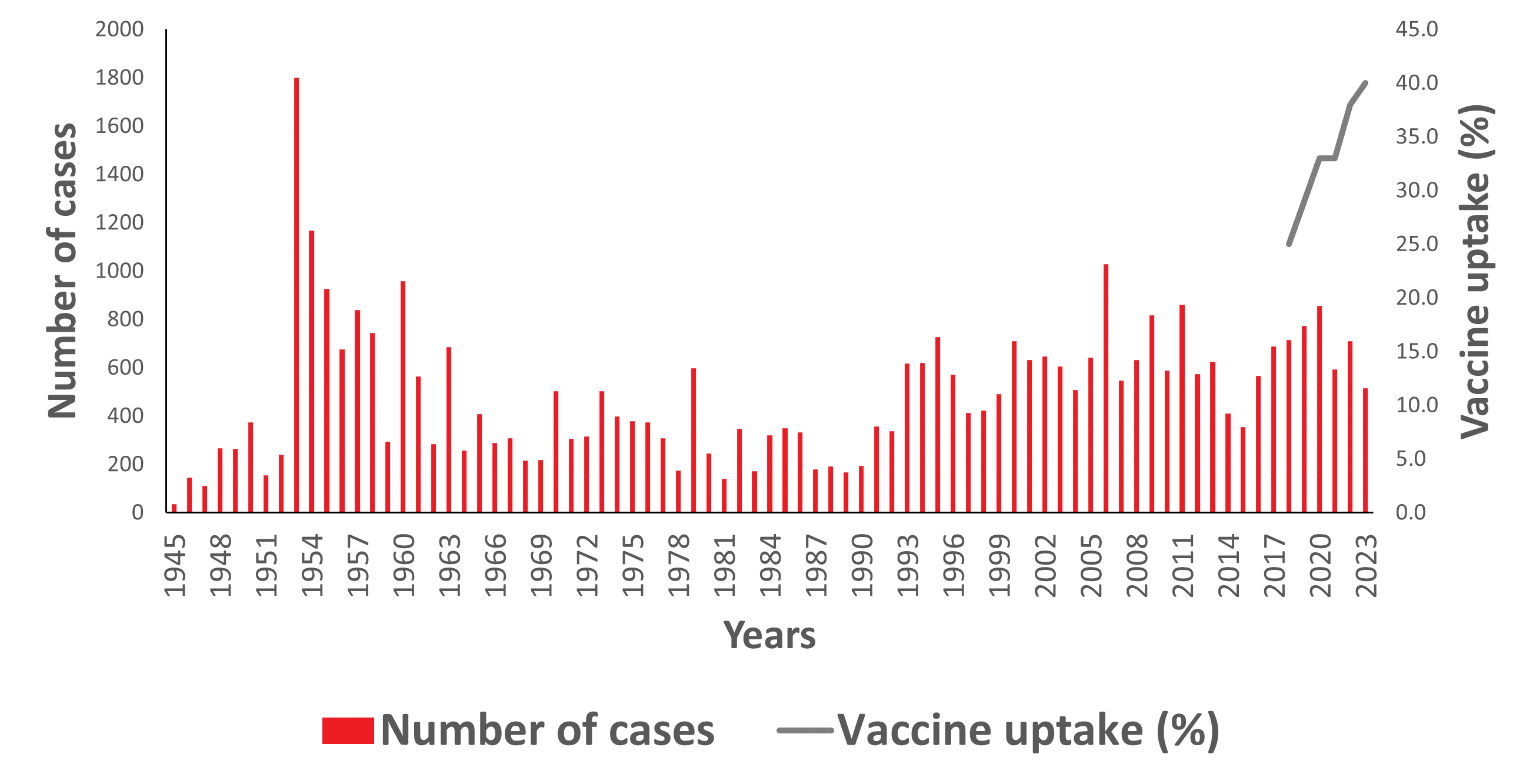
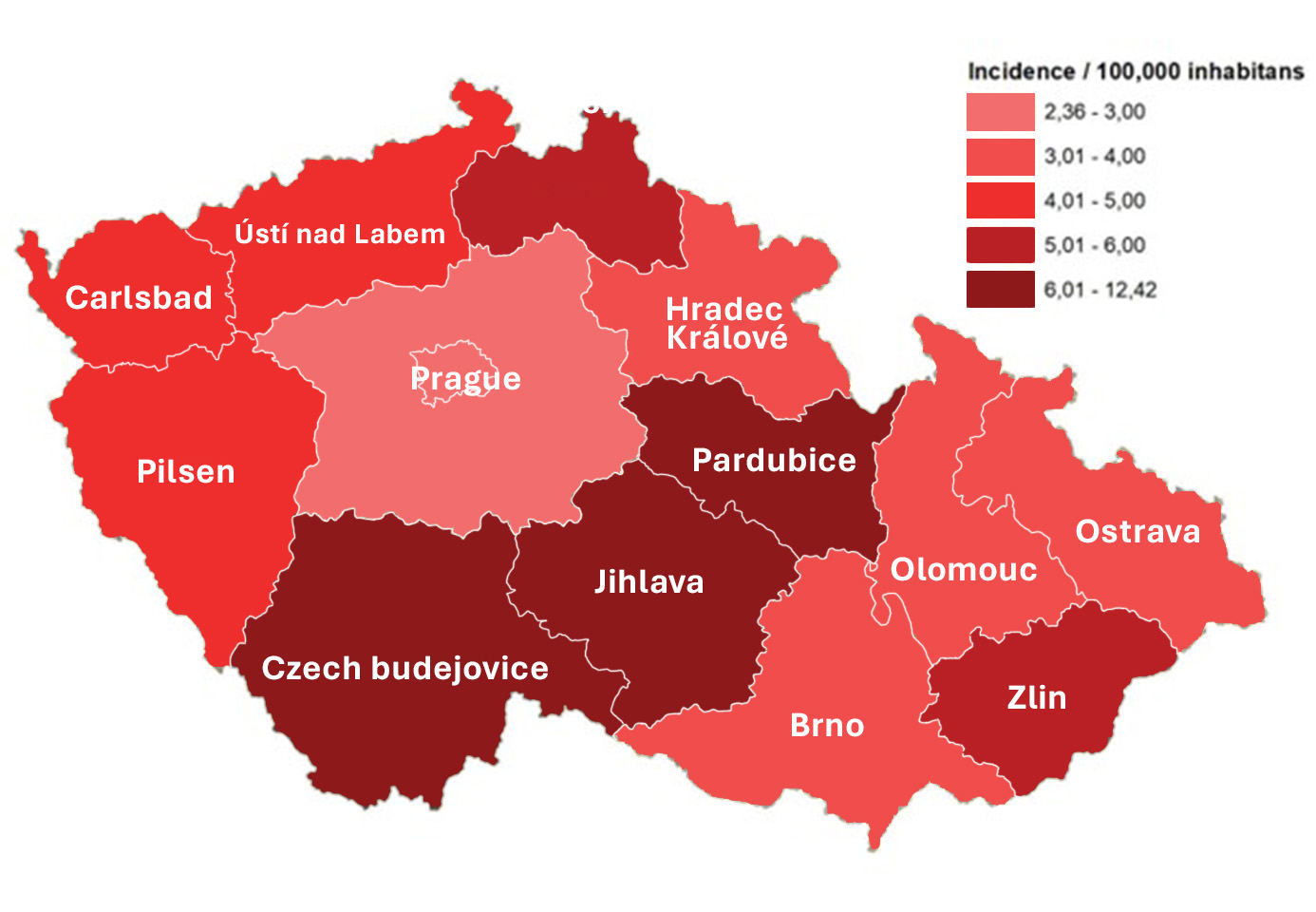
Vaccine uptake is very low, the highest rate is reached in the age group of 18-24 year-olds, the lowest among children younger than 4 years, however there is no central vaccination registry. Data from 8 international telephone surveys in 2009, 2013, 2015, 2018, 2019, 2020, 2021, 2022, and 2023 which covered the whole Czech population and defined a “vaccinated person” as someone having received ≥1 dose vaccine uptake, was estimated to be 16, 23, 24, 25, 29, 33, 33, 38 and 40%, respectively. Substantial regional differences in uptake were observed in the Czech Republic (Prague Region 51%, Pardubice Region 32%). Similar differences in uptake were observed in individual age-groups (18-24 years 64.7%, 0-3 years 18.6%). Unpublished data from some Czech regions indicate that vaccine uptake with ≥3 dose is even lower.
Overview of TBE in the Czech Republic
| Table 1: TBE in the Czech Republic | |
|---|---|
| Viral subtypes isolated | European subtype – no other information available |
| Reservoir animals | Apodemus sylvaticus, Apodemus flavicollis, Myodes glareolus, Microtus agrestis, Sciurus vulgaris, Erinaceus roumanicus, Sorex araneus, Talpa europaea15 |
| Infected tick species (%) | 1970–2023: 157/128,005 (0.123%)18 |
| Dairy product transmission | Rare: 1997-2008: 0.9%13; 1993-2019: 3.4%20; 2007-2023: 0.5%16 Children and adolescents (1993-2019): 6.8%19 |
| Case definition used by authorities | Based on ECDC |
| Type of reporting | Mandatory, only confirmed cases on the basis of clinical and lab criteria are reported1 |
| Other TBE-surveillance | Detection in ticks (National Reference Laboratory for arboviruses) |
| Special clinical features | Biphasic disease: 1994-1997: 80%17 Children and adolescents (1993-2012): 58%12 Risk groups: No information available % with sequelae: children and adolescents (1993-2012): 3%12 Mortality: case fatality rate (1960-2019): 0.79%19; (1970-2008):0.55%14; (2018-2023): 0.5%16 Children and adolescents (1960-2019): 0.2%19 |
| Licensed vaccines | FSME-IMMUN since 1990, Encepur since 1996 |
| Vaccination recommendations | General, first recommendation 1990, last recommendation February 8, 2016 Partial reimbursement from health insurances started in 1993, different strategies of different health insurances in individual years Total reimbursement from health insurances for people 50 years old and over started in 2022 |
| Vaccine uptake | Vaccine uptake in the general population of 16, 23, 24, 25, 29, 33, 33, and 38% (years 2009, 2013, 2015, 2018, 2019, 2020, 2021, 2022 and 20233,4,5,6,7,8,9,10,11) |
| National Reference center for TBE | National Reference Laboratory for arboviruses, Public Health Institute of Ostrava, Partyzánské nám. 7, 702 00 Ostrava https://www.zuova.cz/Home/Page/NRL-arboviry18 |
Figure 1: TBE case numbers over time according to vaccination status. update for 2024: 680 cases; update for 2025: 730 reported cases.
Click the image above to enlarge
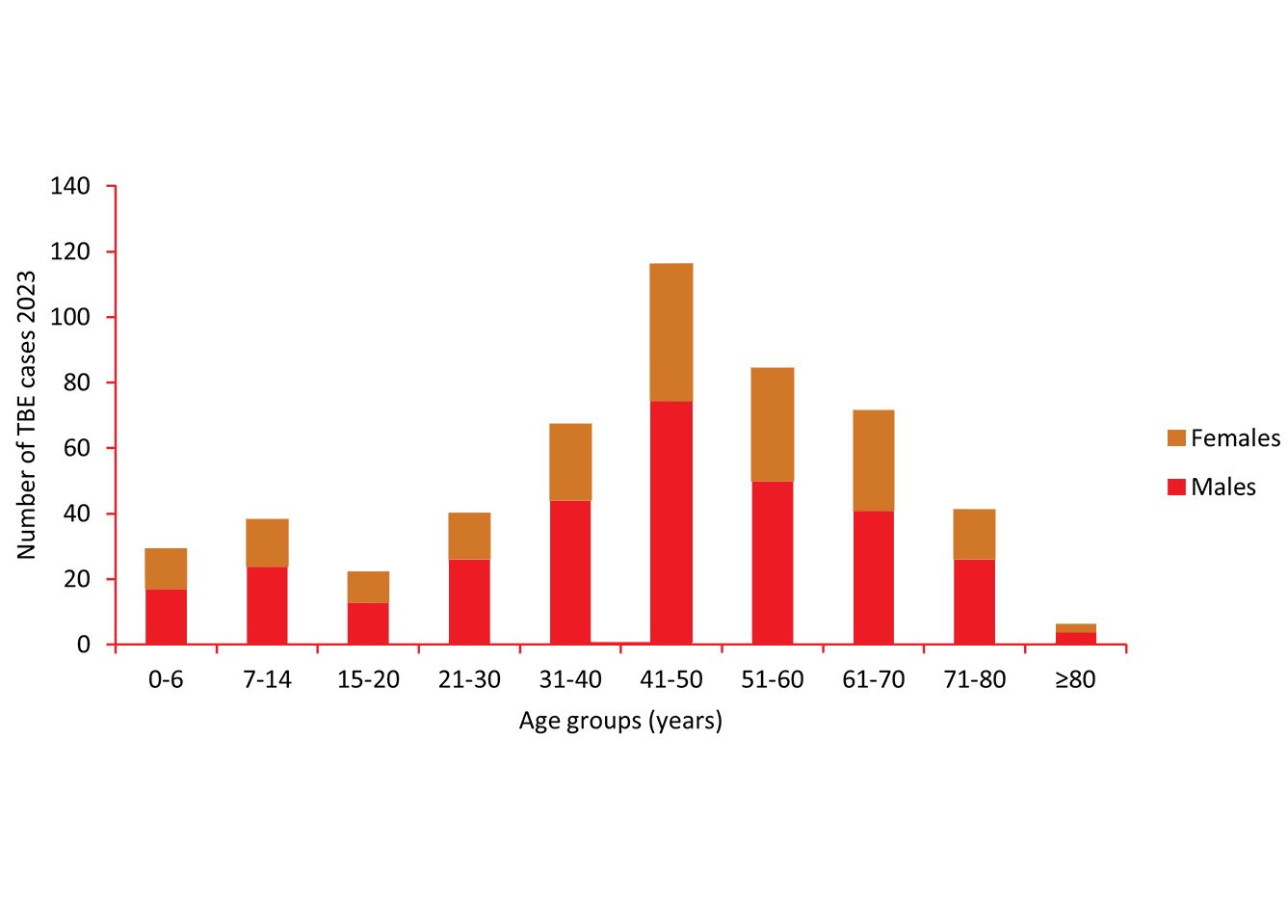
Figure 2: Age and gender distribution of TBE in the Czech Republic (2023)
Click the image above to enlarge
Contact
Petr Pazdiora
pazdiora@fnplzen.cz
Author
Citation
Pazdiora P. TBE in Czech Republic. In: Dobler G, Erber W, Bröker M, Chitimia-Dobler L, Schmitt HJS, eds. The TBE Book. 9th ed. Singapore: Global Health Press; 2026. doi:10.33442/26613980_13-8-9
References
- Daniel M, Benes C, Danielova V, Kriz B. Sixty years of research of tick-borne encephalitis–a basis of the current knowledge of the epidemiological situation in Central Europe. Epidemiol Mikrobiol Imunol. 2011;60(4):135-55.
- Fessel – GfK. Tick-borne encephalitis, a study sponsored by Baxter. 2009.
- Fessel – GfK. Tick-borne encephalitis, a study sponsored by Baxter. 2013.
- Fessel – GfK. Tick-borne encephalitis, a study sponsored by Pfizer. 2016.
- Fessel – GfK. Tick-borne encephalitis, a study sponsored by Pfizer. 2018.
- Ipsos: TBE Awareness Coverage and Compliance Research 2019.
- Ipsos: TBE Awareness Coverage and Compliance Research 2020.
- Ipsos: TBE Awareness Coverage and Compliance Research 2021.
- Ipsos: TBE Awareness Coverage and Compliance Research 2022.
- Krbkova L, Stroblova H., Bednarova J. Clinical course and sequalae for tick-borne encephalitis among children in South Moravia (Czech Republic). Eur J Pediatr. 2015174(4):449-58.
- Kriz B, Benes C, Daniel M. Alimentary transmission of tick-borne encephalitis in the Czech Republic (1997-2008). Epidemiol Mikrobiol Imunol. 2009;58(2):98-103.
- Kriz B, Maly M, Benes C, Daniel M. Epidemiology of tick-borne encephalitis in the Czech Republic 1970-2008. Vector Borne Zoonotic Dis. 2012;12(11):994-9.
- Pazdiora P, Struncova V, Svecova M. Tick-borne encephalitis in children and adolescents in the Czech Republic between 1960 and 2007. World J Pediatr. 2012;8(4):363-6.
- Pazdiora P., Gasparek M. The analysis of the register of compulsorily notifiable diseases (EPIDAT 1993-2017; ISIN 2018-2021) – unpublished data
- Růžek D, Danielova V, Daniel M, Chmelik V, Chrdle A, Pazdiora P, et al. Klíšťová encefalitida. 1st ed. Praha; 2015.
- Zelena H. Průkaz viru KE v klíšťatech, Česká republika 1970-2021. 2022; https://zuova.cz/Home/Page/NRL-arboviry.
- Pazdiora P, Prokopova M, Svecova M, Tomaskova H. Tick-borne Encephalitis in Children and Adolescents in the West Bohemian Region (Czech Republic) between 1960 and 2019. The 29th Meeting of the Czech Society for Epidemiology and Microbiology, PED 2020, in Pilsen, the Czech Republic, from 15-17 September, 2020.
- Pazdiora P, Prokopova M, Kudova J, Tomaskova H. Tick-borne Encephalitis in the West Bohemian Region (Czech Republic) between 1960 and 2021. The Meeting of the Czech Society for Epidemiology and Microbiology, Prague, 1st March 2022.