
This snapshot was prepared by Dr. Irina Kozlova and Dr. Sergey Tkachev and translated based on: Belova et al. Characteristics of genetic variability of tick-borne encephalitis virus in the Ekhirit-Bulagatsky district of the Irkutsk region. Acta Biomed Sci. 2026;11:100-116. doi:10.29413/ABS.2026-11.1.9. (in Russian)
This study had been carried out to analyze the genetic variability of the tick-borne encephalitis virus (TBEV) circulating in the Ekhirit-Bulagatsky District of the Irkutsk Oblast, Eastern Siberia, Russia. This district is part of the Ust-Orda Buryat Okrug, located in the located in the southeast of the Irkutsk Oblast (Figure 1).
Compared to other districts of the Oblast, this area is characterized by a warmer and insufficiently humid climate. The relief of the Ekhirit-Bulagatsky District is a combination of flat areas and hilly elevations, forming a mosaic landscape characterized by a complex mix of steppes, meadows, swamps, and forests with ecotones. Due to the landscape diversity and climatic features, the district provides habitats for several ixodid tick species, such as Ixodes persulcatus, Dermacentor silvarum, D. nuttalli, and Haemaphysalis concinna, as well as sympatric zones for these ixodid species. The fauna of natural TBE foci in the district is diverse and represented by biocenotic assemblages typical of taiga, sub-taiga, forest-steppe, and steppe landscapes. Owing to the unique organization of biological communities in the Ekhirit-Bulagatsky District, the genetic variability of TBEV in this area warrants a more detailed description.
Aim of the study: To characterize the genetic diversity of TBEV virus circulating in the Ekhirit-Bulagatsky District of the Irkutsk Oblast, Eastern Siberia, Russia.
Materials and Methods
Thirty-nine TBEV strains from the collection of the FSBSI SC FHHRP (No. 478258 ckp.rf.ru) isolated from various sources in the Ekhirit-Bulagatsky District were analyzed. A combination of molecular genetic methods (MHNA, Sanger sequencing, and NGS) was used for strain genotyping.
Results and Discussion
The samples for strain isolation were collected from four key locations; a brief description of these locations, along with the TBEV subtypes identified, is provided in Table 1.
| Key location | Coordinates | Altitude | Landscape type | Identified TBEV subtype (abs./%) |
|---|---|---|---|---|
| Oloy (village) | 52°54′N, 105°2′E | 613m | Island steppes and forest-steppes with forb–grass meadow steppes transitioning into pine forests with admixture of birch and aspen or herb–lingonberry ground cover with Dahurian rhododendron |
TBEV-FE (1/7.7%) TBEV-Eur (6/46.2%) TBEV-Sib (5/38.5%) (Vas. (2), Zaus. (2), n.t.(1)) 178-79 (1/7.7%) |
| Komoy (village) | 52°42′N, 104°53′E | 519m | ||
| KrasnyYar, Khim-Dym, Nyrki | 52°32′N, 105°29′E | 690m | Taiga of plains and plateaus with valley larch–lingonberry–green-moss forests and secondary aspen–birch forests |
TBEV-FE (3/13.6%) TBEV-Eur (14.5%) TBEV-Sib (16/72.7%) (Vas. (6), Zaus. (5), n.t. (5)) TBEV-Baik (2/9.1%) |
| Lukovka | 52°39′N, 104°47′E | 510 m |
Although the distance between the village of Oloy and Krasny Yar is approximately 70 km, the TBEV subtype composition at these collection locations differs significantly. In the vicinity of Oloy, half of the studied strains belong to the European subtype, one third to the Siberian subtype, one Far Eastern subtype strain was identified, and a strain 178-79 previously considered unique was also detected. Currently, isolates with 99.59% similarity to strain 178-79 have been reported in China (Guo M, Liu H, Zhou H, et.al. The risk of pathogenic tick-borne viruses in Northeast Asia: a genomic and ecological modelling study. Sci China Life Sci. 2026 Feb 13. doi: 10.1007/s11427-025-3146-2).
Among TBEV strains from the foothill forests of the Onot Upland (taiga of plains and plateaus), strains of the Siberian subtype dominate (72.7%). Three Far Eastern subtype strains, two Baikalian subtype strains, and only one European subtype strain were identified. These two collection locations share the same type of relief (plains and plateaus) but differ in landscape type – taiga versus island steppes and forest-steppes.
Based on the analysis results, we have compiled a schematic map of TBEV subtype distribution in the Ekhirit-Bulagatsky District (Figure 1).
Figure 1: Map of the distribution of various TBEV subtypes in the Ekhirit-Bulagatsky District of the Irkutsk Oblast.
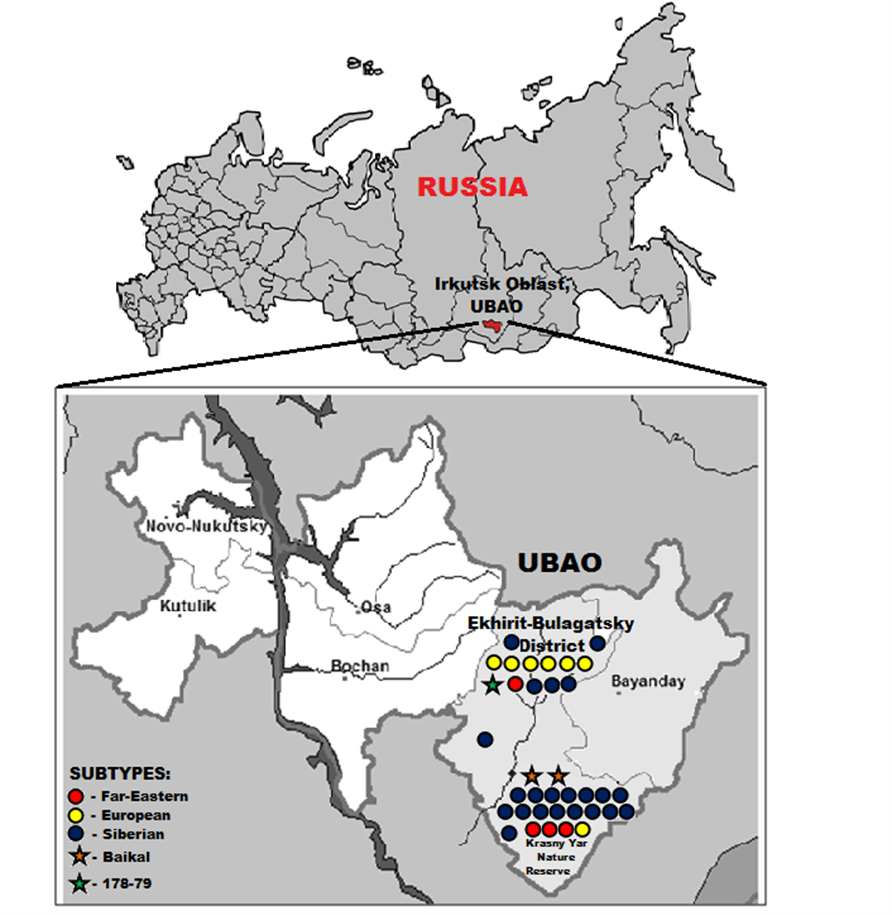
It should be noted that the distribution of different TBEV subtypes among strains isolated from ixodid ticks and vertebrate animals differed (Table 2). Although the collection is characterized by an uneven distribution of strains isolated from ixodid ticks versus warm-blooded animals, it can be hypothesized that ixodid ticks act as amplifiers of the TBEV Siberian subtype, and that a change of vectors during TBEV circulation in nature may influence the ratio of different virus subtypes and lead to the formation of a heterogeneous viral population.
| Isolation source | Subtype | |||||
|---|---|---|---|---|---|---|
| TBEV-FE | TBEV-Eur | TBEV-Sib | TBEV-Baik | 178-79 | Total | |
| I. persulcatus | 3 | 3 |
23 (Zaus. – 6; Vas. – 7; n.t. – 10) |
2 | 1 | 32 |
| Small mammals | – | 4 | – | – | – | 4 |
| Human TBE patient | – | – | 1 (Vas.) | – | – | 1 |
| Cow’s milk | 1 | – | 1 (Vas.) | – | – | 2 |
The influence of landscape diversity and the associated flora and fauna on the formation of TBEV genetic diversity can be clearly demonstrated by the genetic diversity of the virus in the Krasny Yar State Federal Biological Reserve. Of the 39 TBEV strains studied, 13 were isolated from samples collected in this reserve.
The reserve is located in the foothills of the Primorsky Range, on the western macroslope of the Onot Upland, in the watershed area of the Kuda River and Lake Baikal. Its territory belongs to the taiga zone, subzone of southern taiga, and belt of dark-coniferous taiga; the lower boundary of the belt is 500 m above sea level (a.s.l.), the upper boundary is 943 m a.s.l.
Most of the reserve’s area has flat relief, but eleven landscape types occur here, which can be conditionally divided into three groups: South Siberian mountain-taiga; South Siberian sub-taiga; floodplain: limited-development valley forests, valley swampy meadows, valley sedge–grass meadow–marsh solonetzic steppes (of Dahurian type).
The fauna of the reserve is highly diverse; as of 2021, 41 mammal species were recorded, dominated by rodents, insectivores, and carnivores. The reserve hosts a typical Baikal-region composition of mammalian fauna, with a predominance of Siberian-type species, as well as the presence of European species, trans-Palaearctic species, tundra–forest-steppe relict species, and isolated representatives of the Siberian–Chinese and Mediterranean–Chinese faunal types.
At least three ixodid tick species inhabit the reserve. The overlapping ranges of different landscape types and the small mammals belonging to different geographic types create conditions for maintaining a heterogeneous viral population on this territory, represented by four TBEV subtypes (Far Eastern, Siberian (lineages “Vasilchenko” and “Zausaev”), European, and Baikalian).
Another factor that may influence TBEV genetic variability and facilitate the spread of different TBEV subtypes is the diversity of avifauna. Birds in the Krasny Yar Reserve are represented by 132 species, many of which are migratory. The Baikal region, including the Ekhirit-Bulagatsky District, is an important crossroads for bird migration routes from northern and western regions to wintering grounds in Mongolia, Korea, China, India, and Australia. Since migratory birds can carry ticks over long distances, there is a potential for the introduction of various TBEV genetic variants from these countries.
A comparative analysis of the genome coding regions of the strains from the Ekhirit-Bulagatsky District and other districts of the Irkutsk Oblast has been performed. The analysis revealed unique amino acid substitutions in structural and non-structural viral proteins that are characteristic only of strains from the studied district. This is most clearly demonstrated using the example of the Siberian TBEV subtype. TBEV-Sib strains from the Ekhirit-Bulagatsky District exhibited the highest number of unique amino acid substitutions.
The genetic structure of TBEV European subtype strains is characterized by high stability. European TBEV strains from the Irkutsk Oblast form a single cluster, independent of temporal, geographic, and ecological isolation factors. The similarity level of the genome coding region of European TBEV strains isolated in the Irkutsk Oblast was 99.8–99.9%. This similarity level has been observed for over 40 years (from 1967 to 2010). Analysis of the coding region sequence revealed only two mutations in European TBEV strains isolated from samples collected in the Ekhirit-Bulagatsky District. One of these, in strain 118-71 isolated from a long-tailed ground squirrel captured near the Oloy village, is a substitution in the NS3 protein (Arg247→Lys). Strain 262-74, isolated from a pool of taiga ticks collected near Oloy, contains a glycine-to-serine substitution at position 250 of the NS4b protein (Gly250→Ser) as demonstrated by polyprotein sequence analysis.
Strain 178-79 is characterized by a high degree of genetic uniqueness compared to strains of other TBEV subtypes. The maximum difference level reaches 17.9% compared to European TBEV strains, and the minimum (11.7%) is observed when compared to the Far Eastern strain M442. This difference degree makes strain 178-79 genetically unique not only within the Ekhirit-Bulagatsky District but also across the entire Irkutsk Oblast.
In the view of the authors, the detection of strains with a mosaic structure, such as Baikalian subtype strains or strain 178-79, in the Ekhirit-Bulagatsky District is not coincidental. Long-term co-circulation of several TBEV subtypes in the same area creates prerequisites for genetic exchange.
At the same time, common amino acid substitutions were found in TBEV strains from the Ekhirit-Bulagatsky and other districts of the Irkutsk Oblast, indicating the absence of strict isolation of the viral population circulating in TBE foci. Thus, this research has demonstrated that the Ekhirit-Bulagatsky District is unique in terms of TBEV genetic variability, characterized by a wide range of circulating subtypes and the presence of original amino acid substitutions within individual virus subtypes.
Author: Dr. Irina Kozlova and Dr. Sergey Tkachev (Editor: Dr. Michael Bröker )
Compiled: April 2026