Bondaryuk A,
Bukin Y. Resolving the Orthoflavivirus encephalitidis paraphyly by species splitting. Taxonomy. 2026;6(3):52. doi:10.3390/taxonomy6030052
Tick-borne encephalitis virus (TBEV) is a medically significant arthropod-borne flavivirus that has been studied for nearly ninety years since its first isolation in 1937. The virus possesses a positive-sense, single-stranded RNA genome of approximately 11,000 nucleotides, encoding a polyprotein that is processed into three structural and seven non-structural proteins.
TBEV is transmitted primarily by hard ticks of the genus Ixodes and circulates between ticks and small mammalian reservoir hosts, causing several thousand human cases of tick-borne encephalitis annually across Eurasia. Based on genetic and geographic criteria, TBEV has traditionally been divided into five subtypes: European, Far-Eastern, Siberian, Baikalian, and Himalayan.
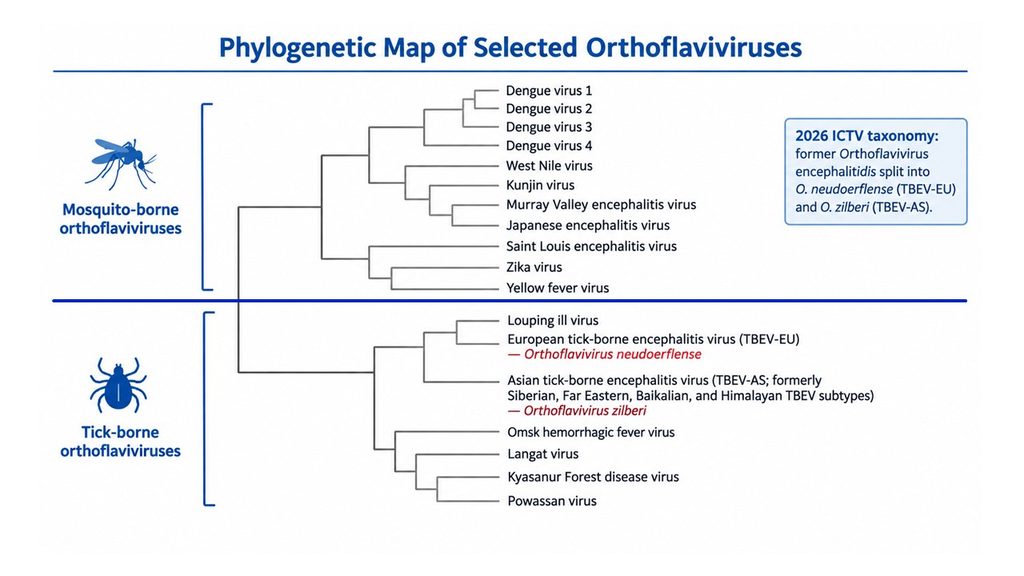
A long-standing phylogenetic problem concerns the relationship between TBEV and louping-ill virus (LIV), a closely related tick-borne flavivirus first identified in 1931. Although LIV is classified as a separate species, molecular phylogenies consistently place it as the sister lineage to the European subtype of TBEV, making the species Orthoflavivirus encephalitidis (the former TBEV species) paraphyletic. This conflicts with the International Committee on Taxonomy of Viruses (ICTV) requirement that species represent monophyletic groups. Two possible solutions have been discussed: either merge TBEV and LIV into a single species or elevate the European subtype of TBEV to the rank of a separate species. The first approach has been repeatedly proposed but is not well supported by the full set of demarcation criteria for the genus Orthoflavivirus, including antigenic properties, vector and host associations, and disease characteristics.
In 2026, the ICTV ratified our taxonomic proposal, which follows the second approach. The former species Orthoflavivirus encephalitidis was split into two monophyletic species: Orthoflavivirus zilberi, named after Lev A. Zilber, and Orthoflavivirus neudoerflense, named after the Austrian town of Neudörfl, where the reference strain was isolated. To avoid ambiguity in the common virus name “tick-borne encephalitis virus,” the authors propose the designations Asian TBEV (TBEV-AS) for Orthoflavivirus zilberi and European TBEV (TBEV-EU) for Orthoflavivirus neudoerflense.
The revised taxonomy eliminates the paraphyly within tick-borne flaviviruses and provides a clear framework for naming and communication. By recognizing Orthoflavivirus zilberi and Orthoflavivirus neudoerflense as separate species, the new classification reflects not only phylogenetic relationships but also differences in ecology, antigenicity, and clinical presentation. This should improve the precision of surveillance, diagnostics, and vaccine strain selection. Further studies of under-sampled lineages, such as the Baikalian subtype, may refine species boundaries even further.
This snapshot has been prepared by Artem Bondaryuk, Irkutsk, Russia.