


Page 205 - TBE_Book_V2_2019
P. 205
Chapter 11: General epidemiology of TBE


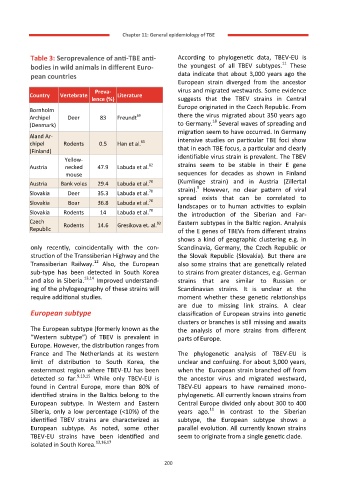
          Table 3: Seroprevalence of anti-TBE anti-   According  to  phylogenetic  data,  TBEV-EU  is
                                                                                     11
          bodies in wild animals in different Euro-   the  youngest  of  all  TBEV  subtypes.   These
          pean countries                              data indicate that about 3,000 years ago the
                                                      European  strain  diverged  from  the  ancestor
                             Preva-                   virus and migrated westwards. Some evidence
          Country   Vertebrate      Literature
                            lence (%)                 suggests  that  the  TBEV  strains  in  Central
                                                      Europe originated in the Czech Republic. From
          Bornholm
                                          69
          Archipel   Deer      83   Freundt           there the virus migrated about 350 years ago
                                                                18
          (Denmark)                                   to Germany.  Several waves of spreading and
                                                      migration seem to have occurred. In Germany
          Aland Ar-                                   intensive  studies  on  particular  TBE  foci  show
                                           81
          chipel    Rodents   0.5   Han et al.
          (Finland)                                   that in each TBE focus, a particular and clearly
                                                      identifiable virus strain is prevalent. The TBEV
                    Yellow-
                                             82
          Austria   necked    47.9   Labuda et al.    strains  seem  to  be  stable  in  their  E  gene
                    mouse                             sequences  for  decades  as  shown  in  Finland
                                             70
          Austria   Bank voles   29.4   Labuda et al.    (Kumlinge  strain)  and  in  Austria  (Zillertal
                                                           9
                                             70
          Slovakia   Deer     35.3   Labuda et al.    strain).   However,  no  clear  pattern  of  viral
                                                      spread  exists  that  can  be  correlated  to
                                             70
          Slovakia   Boar     36.8   Labuda et al.
                                                      landscapes  or  to  human  activities  to  explain
                                             70
          Slovakia   Rodents   14   Labuda et al.     the  introduction  of  the  Siberian  and  Far-
          Czech     Rodents   14.6   Gresikova et. al.    Eastern subtypes in the Baltic region. Analysis
                                               83
          Republic                                    of the E genes of TBEVs from different strains

                                                      shows  a  kind  of  geographic  clustering  e.g.  in
          only  recently,  coincidentally  with  the  con-  Scandinavia, Germany, the  Czech Republic or
          struction of the Transsiberian Highway and the   the  Slovak  Republic  (Slovakia).  But  there  are
                             12
          Transsiberian  Railway.   Also,  the  European   also some strains that are genetically related
          sub-type  has  been  detected  in  South  Korea   to strains from greater distances, e.g. German
          and also in Siberia. 13,14  Improved understand-  strains  that  are  similar  to  Russian  or
          ing of the phylogeography of these strains will   Scandinavian  strains.  It  is  unclear  at  the
          require additional studies.                 moment  whether  these  genetic  relationships
                                                      are  due  to  missing  link  strains.  A  clear
          European subtype                            classification of European strains into genetic
                                                      clusters or branches is still missing and awaits
          The European subtype (formerly known as the   the  analysis  of  more  strains  from  different
          “Western  subtype”)  of  TBEV  is  prevalent  in   parts of Europe.
          Europe. However, the distribution ranges from
          France  and  The  Netherlands  at  its  western   The  phylogenetic  analysis  of  TBEV-EU  is
          limit  of  distribution  to  South  Korea,  the   unclear and confusing. For about 3,000 years,
          easternmost region where TBEV-EU has been   when the  European strain branched off from
          detected  so  far. 9,13,15   While  only  TBEV-EU  is   the  ancestor  virus  and  migrated  westward,
          found  in  Central  Europe,  more  than  80%  of   TBEV-EU  appears  to  have  remained  mono-
          identified  strains  in  the  Baltics  belong  to  the   phylogenetic. All currently known strains from
          European  subtype.  In  Western  and  Eastern   Central Europe divided only about 300 to 400
                                                               11
          Siberia,  only  a  low  percentage  (<10%)  of  the   years  ago.   In  contrast  to  the  Siberian
          identified  TBEV  strains  are  characterized  as   subtype,  the  European  subtype  shows  a
          European  subtype.  As  noted,  some  other   parallel evolution. All currently known strains
          TBEV-EU  strains  have  been  identified  and   seem to originate from a single genetic clade.
          isolated in South Korea. 13,16,17

                                                  200

