


Page 219 - TBE_Book_V2_2019
P. 219
Chapter 12a: Epidemiology by country – overview


          potential risk of exposure, depending on their   bases available, it is fair to conclude that the
          activity and mobility.                      true  TBEV  disease  burden  is  significantly
                                                                   3,8
                                                      underestimated.
           Recommendations in other countries, if they
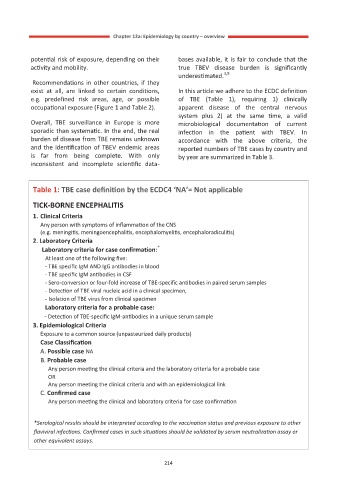
          exist  at  all,  are  linked  to  certain  conditions,   In this article we adhere to the ECDC definition
          e.g.  predefined  risk  areas,  age,  or  possible   of  TBE  (Table  1),  requiring  1)  clinically
          occupational exposure (Figure 1 and Table 2).   apparent  disease  of  the  central  nervous
                                                      system  plus  2)  at  the  same  time,  a  valid
          Overall,  TBE  surveillance  in  Europe  is  more   microbiological  documentation  of  current
          sporadic than systematic. In the end, the real   infection  in  the  patient  with  TBEV.  In
          burden of disease from TBE remains unknown   accordance  with  the  above  criteria,  the
          and the identification of TBEV endemic areas   reported numbers of TBE cases by country and
          is  far  from  being  complete.  With  only   by year are summarized in Table 3.
          inconsistent  and  incomplete  scientific  data-


           Table 1: TBE case definition by the ECDC4 ‘NA’= Not applicable
           TICK-BORNE ENCEPHALITIS
           1. Clinical Criteria
             Any person with symptoms of inflammation of the CNS
             (e.g. meningitis, meningoencephalitis, encephalomyelitis, encephaloradiculitis)
           2. Laboratory Criteria
                                                *
              Laboratory criteria for case confirmation:
                   At least one of the following five:
              - TBE specific IgM AND IgG antibodies in blood
              - TBE specific IgM antibodies in CSF
              - Sero-conversion or four-fold increase of TBE-specific antibodies in paired serum samples
              - Detection of TBE viral nucleic acid in a clinical specimen,
              - Isolation of TBE virus from clinical specimen
              Laboratory criteria for a probable case:
              - Detection of TBE-specific IgM-antibodies in a unique serum sample
           3. Epidemiological Criteria
             Exposure to a common source (unpasteurized daily products)
             Case Classification
             A. Possible case NA
             B. Probable case
               Any person meeting the clinical criteria and the laboratory criteria for a probable case
               OR
               Any person meeting the clinical criteria and with an epidemiological link
             C. Confirmed case
               Any person meeting the clinical and laboratory criteria for case confirmation


           *Serological results should be interpreted according to the vaccination status and previous exposure to other
           flaviviral infections. Confirmed cases in such situations should be validated by serum neutralization assay or
           other equivalent assays.


                                                  214
                                                  214

