


Page 258 - TBE_Book_V2_2019
P. 258
Chapter 12b: TBE in China


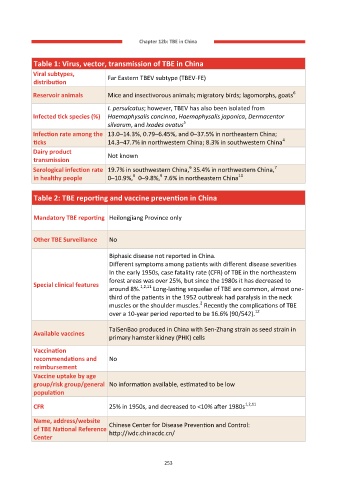
           Table 1: Virus, vector, transmission of TBE in China
           Viral subtypes,
                                 Far Eastern TBEV subtype (TBEV-FE)
           distribution
                                                                                        6
           Reservoir animals     Mice and insectivorous animals; migratory birds; lagomorphs, goats
                                 I. persulcatus; however, TBEV has also been isolated from
           Infected tick species (%)  Haemaphysalis concinna, Haemaphysalis japonica, Dermacentor
                                                       5
                                 silvarum, and Ixodes ovatus
           Infection rate among the  13.0–14.3%, 0.79–6.45%, and 0–37.5% in northeastern China;
                                                                                     4
           ticks                 14.3–47.7% in northwestern China; 8.3% in southwestern China
           Dairy product
                                 Not known
           transmission
                                                                                  7
                                                         6
           Serological infection rate  19.7% in southwestern China,  35.4% in northwestern China,
                                                9
                                        8
                                                                        10
           in healthy people     0–10.9%,   0–9.8%,  7.6% in northeastern China
           Table 2: TBE reporting and vaccine prevention in China
           Mandatory TBE reporting  Heilongjiang Province only


           Other TBE Surveillance   No

                                 Biphasic disease not reported in China.
                                 Different symptoms among patients with different disease severities
                                 In the early 1950s, case fatality rate (CFR) of TBE in the northeastern
                                 forest areas was over 25%, but since the 1980s it has decreased to
           Special clinical features       1,2,11
                                 around 8%.    Long-lasting sequelae of TBE are common, almost one-
                                 third of the patients in the 1952 outbreak had paralysis in the neck
                                                            2
                                 muscles or the shoulder muscles.  Recently the complications of TBE
                                                                             12
                                 over a 10-year period reported to be 16.6% (90/542).
                                 TaiSenBao produced in China with Sen-Zhang strain as seed strain in
           Available vaccines
                                 primary hamster kidney (PHK) cells
           Vaccination
           recommendations and   No
           reimbursement
           Vaccine uptake by age
           group/risk group/general  No information available, estimated to be low
           population
           CFR                   25% in 1950s, and decreased to <10% after 1980s 1,2,11

           Name, address/website
                                 Chinese Center for Disease Prevention and Control:
           of TBE National Reference   http://ivdc.chinacdc.cn/
           Center


                                                  253

