


Page 344 - TBE_Book_V2_2019
P. 344
Chapter 12b: TBE in Mongolia


          Overview of TBE in Mongolia

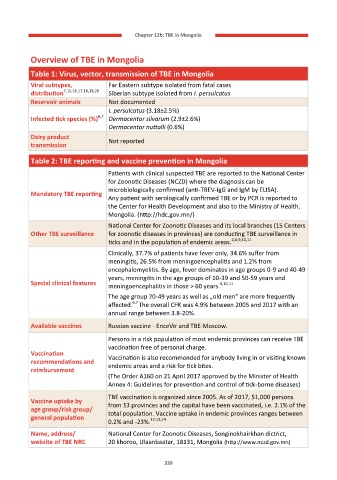
           Table 1: Virus, vector, transmission of TBE in Mongolia
          Viral subtypes,        Far Eastern subtype isolated from fatal cases
          distribution 7,15,16,17,18,19,20    Siberian subtype isolated from I. persulcatus
          Reservoir animals      Not documented
                                 I. persulcatus (3.18±2.5%)
                              6,7
          Infected tick species (%)   Dermacentor silvarum (2.9±2.6%)
                                 Dermacentor nuttalli (0.6%)
          Dairy product
                                 Not reported
          transmission
           Table 2: TBE reporting and vaccine prevention in Mongolia
                                 Patients with clinical suspected TBE are reported to the National Center
                                 for Zoonotic Diseases (NCZD) where the diagnosis can be
                                 microbiologically confirmed (anti-TBEV-IgG and IgM by ELISA).
          Mandatory TBE reporting
                                 Any patient with serologically confirmed TBE or by PCR is reported to
                                 the Center for Health Development and also to the Ministry of Health,
                                 Mongolia. (http://hdc.gov.mn/)
                                 National Center for Zoonotic Diseases and its local branches (15 Centers
          Other TBE surveillance   for zoonotic diseases in provinces) are conducting TBE surveillance in
                                 ticks and in the population of endemic areas. 4,6,9,10,11
                                 Clinically, 37.7% of patients have fever only, 34.6% suffer from
                                 meningitis, 26.5% from meningoencephalitis and 1.2% from
                                 encephalomyelitis. By age, fever dominates in age groups 0-9 and 40-49
                                 years, meningitis in the age groups of 10-39 and 50-59 years and
          Special clinical features                               6,10,11
                                 meningoencephalitis in those > 60 years.
                                 The age group 20-49 years as well as „old men” are more frequently
                                        6,7
                                 affected.   The overall CFR was 4.9% between 2005 and 2017 with an
                                 annual range between 3.8-20%.

          Available vaccines     Russian vaccine - EnceVir and TBE-Moscow.
                                 Persons in a risk population of most endemic provinces can receive TBE
                                 vaccination free of personal charge.
          Vaccination
                                 Vaccination is also recommended for anybody living in or visiting known
          recommendations and
                                 endemic areas and a risk for tick bites.
          reimbursement
                                 (The Order A160 on 21 April 2017 approved by the Minister of Health
                                 Annex 4: Guidelines for prevention and control of tick-borne diseases)
                                 TBE vaccination is organized since 2005. As of 2017, 51,000 persons
          Vaccine uptake by
                                 from 13 provinces and the capital have been vaccinated, i.e. 2.1% of the
          age group/risk group/
                                 total population. Vaccine uptake in endemic provinces ranges between
          general population                  12,13,14
                                 0.2% and -23%.
          Name, address/         National Center for Zoonotic Diseases, Songinokhairkhan dictrict,
          website of TBE NRC     20 khoroo, Ulaanbaatar, 18131, Mongolia (http://www.nczd.gov.mn)


                                                  339

