


Page 461 - TBE_Book_V2_2019
P. 461
Chapter 14: Prevention


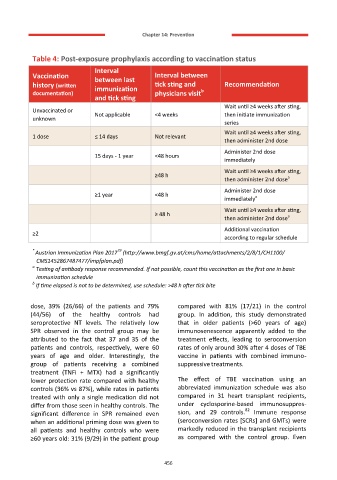
           Table 4: Post-exposure prophylaxis according to vaccination status
                             Interval
           Vaccination                         Interval between
                             between last
           history (written   immunization     tick sting and      Recommendation
                                                             b
           documentation)                      physicians visit
                             and tick sting
                                                                   Wait until ≥4 weeks after sting,
           Unvaccinated or
                             Not applicable    <4 weeks            then initiate immunization
           unknown
                                                                   series
                                                                   Wait until ≥4 weeks after sting,
           1 dose            ≤ 14 days         Not relevant
                                                                   then administer 2nd dose
                                                                   Administer 2nd dose
                             15 days - 1 year   <48 hours
                                                                   immediately
                                                                   Wait until ≥4 weeks after sting,
                                               ≥48 h                                  a
                                                                   then administer 2nd dose
                                                                   Administer 2nd dose
                             ≥1 year           <48 h                         a
                                                                   immediately
                                                                   Wait until ≥4 weeks after sting,
                                               ≥ 48 h                                 a
                                                                   then administer 2nd dose
                                                                   Additional vaccination
           ≥2
                                                                   according to regular schedule
           *                        79
           Austrian Immunization Plan 2017  (http://www.bmgf.gv.at/cms/home/attachments/2/8/1/CH1100/
            CMS1452867487477/impfplan.pdf)
           a
            Testing of antibody response recommended. If not possible, count this vaccination as the first one in basic
            immunization schedule
           b
            If time elapsed is not to be determined, use schedule: >48 h after tick bite

          dose,  39%  (26/66)  of  the  patients  and  79%   compared  with  81%  (17/21)  in  the  control
          (44/56)  of  the  healthy  controls  had    group.  In  addition,  this  study  demonstrated
          seroprotective  NT  levels.  The  relatively  low   that  in  older  patients  (>60  years  of  age)
          SPR  observed  in  the  control  group  may  be   immunosenescence  apparently  added  to  the
          attributed  to  the  fact  that  37  and  35  of  the   treatment  effects,  leading  to  seroconversion
          patients  and  controls,  respectively,  were  60   rates of only around 30% after 4 doses of TBE
          years  of  age  and  older.  Interestingly,  the   vaccine  in  patients  with  combined  immuno-
          group  of  patients  receiving  a  combined   suppressive treatments.
          treatment  (TNFi  +  MTX)  had  a  significantly
          lower protection rate compared with healthy   The  effect  of  TBE  vaccination  using  an
          controls (36% vs 87%), while rates in patients   abbreviated  immunization  schedule  was  also
          treated with only a single medication did not   compared  in  31  heart  transplant  recipients,
          differ from those seen in healthy controls. The   under  cyclosporine-based  immunosuppres-
                                                                          82
          significant  difference  in  SPR  remained  even   sion,  and  29  controls.   Immune  response
          when an additional priming dose was given to   (seroconversion rates [SCRs] and GMTs) were
          all  patients  and  healthy  controls  who  were   markedly reduced in the transplant recipients
          ≥60 years old: 31% (9/29) in the patient group   as  compared  with  the  control  group.  Even


                                                  456

