


Page 110 - TBE_Book_V2_2019
P. 110
Chapter 5


                                TBE in adults


                        Johannes P. Borde and Joanna Zajkowska

          Key Points:

           •  TBE is the most important tick-borne arbovirus disease of humans. Epidemiological data indi-
             cate a trend towards an increasing severity with higher age.

           •  A number of possible genetic and non-genetic risk factors have been identified, which might
             have an impact on the manifestation and severity of human disease.

           •  Different TBEV strains seem to cause differing clinical courses of disease. While the TBE-Eu
             mainly causes a biphasic course, the clinical course of TBEV-FE and TBEV-Sib are mainly mo-
             nophasic.
           •  The diagnosis of TBE is based on serological tests.
           •  So far there is no effective treatment of TBEV infections.


          Introduction
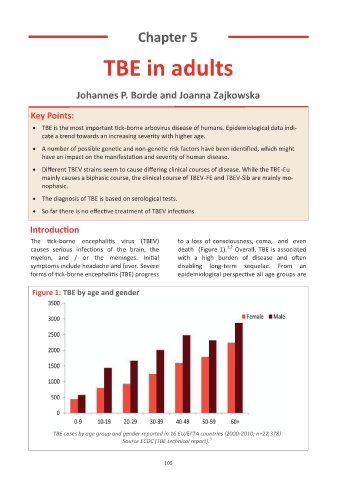
          The  tick-borne  encephalitis  virus  (TBEV)   to a loss of consciousness, coma,  and  even
                                                                    1,2
          causes  serious  infections  of  the  brain,  the   death  (Figure 1).  Overall, TBE is associated
          myelon,  and  /  or  the  meninges.  Initial   with  a  high  burden  of  disease  and  often
          symptoms include headache and fever. Severe   disabling  long-term  sequelae.  From  an
          forms of tick-borne encephalitis (TBE) progress   epidemiological perspective all age groups are

           Figure 1: TBE by age and gender


                 TBE cases by age group and gender reported in 16 EU/EFTA countries (2000-2010; n=22,378)
                                                               3
                                     Source ECDC (TBE technical report).

                                                  105

