


Page 115 - TBE_Book_V2_2019
P. 115
Chapter 5: TBE in adults


          patterns  (PAMPs),  cell  migration,  and   Clinical course
          interaction  with  T  lymphocytes,  potentially
          contributing  to  an  early  response  to  TBEV  at
          the  site  of  tick  feeding  and  initiation  of  a   Pathogenesis – preclinic phase
          specific  immune  response.  It  is  coded  by
                                      19
          CD209 gene on the chromosome.  Findings in   After a tick bite, the released TBEV in the skin
          the  context  of  dengue  virus  and  HCV   replicates subcutaneously and is, in this early
          infections  pointed  to  an  increased  risk  of   stage, limited to the skin. Dendritic cells of the
          dengue  hemorrhagic  fever  and  advanced   skin, the Langerhans cells, bind with antigens
          hepatic injury in hepatitis C when there is an   and subsequently induce an immune response
          underlying  SNP  (rs4804803)  located  in  the   by  producing  proinflammatory  cytokines.
                                               34
          promoter  region  of  the  CD209  gene.     After  the  initial  replication  in  the  skin,  TBEV
          Dendritic  cells  in  the  skin  and  gut  probably   replicates  in  the  lymph  nodes  and  lymphatic
          play  an  important  role  in  the  early  stages  of   system,  leading  to  viremia.  DCs  and
          TBEV infection. These antigen-presenting cells   macrophages  are  crucially  involved  in  TBEV
          act  as  a  source  of  pro-inflammatory  and   replication, and may contribute to the spread
          antiviral  mediators  and  as  initiators  of  a   to  uninfected  cells,  thereby  serving  as  an
          specific immune response. However, this cell   important  source  of  local  virus  replication
          type  is  susceptible  to  TBEV  as  well  and   before viremia occurs. 35,36
          facilitates the initial spread of TBEV from the
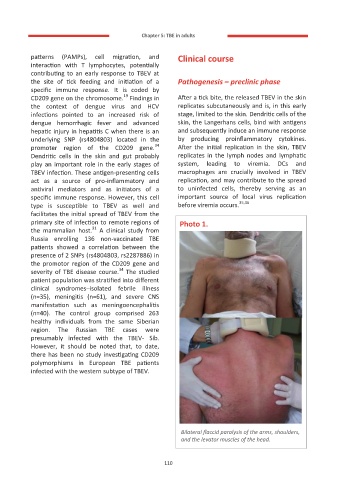
          primary site of infection to remote regions of   Photo 1.
                            31
          the  mammalian  host.   A  clinical  study  from
          Russia  enrolling  136  non-vaccinated  TBE
          patients  showed  a  correlation  between  the
          presence of 2 SNPs (rs4804803, rs2287886) in
          the  promotor  region  of  the  CD209  gene  and
                                    34
          severity  of  TBE  disease  course.   The  studied
          patient population was stratified into different
          clinical  syndromes–isolated  febrile  illness
          (n=35),  meningitis  (n=61),  and  severe  CNS
          manifestation  such  as  meningoencephalitis
          (n=40).  The  control  group  comprised  263
          healthy  individuals  from  the  same  Siberian
          region.  The  Russian  TBE  cases  were
          presumably  infected  with  the  TBEV-  Sib.
          However,  it  should  be  noted  that,  to  date,
          there has been no study investigating  CD209
          polymorphisms  in  European  TBE  patients
          infected with the western subtype of TBEV.


                                                       Bilateral flaccid paralysis of the arms, shoulders,
                                                       and the levator muscles of the head.


                                                  110
                                                  110

