


Page 117 - TBE_Book_V2_2019
P. 117
Chapter 5: TBE in adults


                                                      fatigue,  myalgia,  anorexia,  nausea,  and
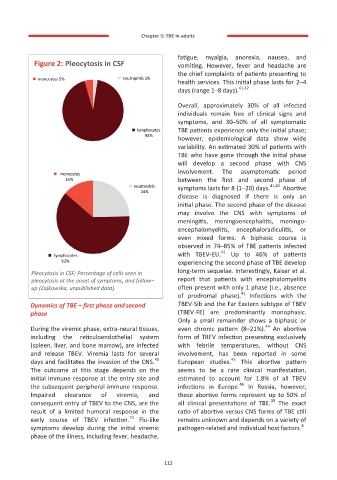
            Figure 2: Pleocytosis in CSF              vomiting.  However,  fever  and  headache  are
                                                      the chief complaints of patients presenting to
                                                      health services. This initial phase lasts for 2–4
                                                      days (range 1–8 days). 41,42

                                                      Overall,  approximately  30%  of  all  infected
                                                      individuals  remain  free  of  clinical  signs  and
                                                      symptoms,  and  30–50%  of  all  symptomatic
                                                      TBE patients experience only the initial phase;
                                                      however,  epidemiological  data  show  wide
                                                      variability. An estimated 30% of patients with
                                                      TBE who have gone through the initial phase
                                                      will  develop  a  second  phase  with  CNS
                                                      involvement.   The   asymptomatic   period
                                                      between  the  first  and  second  phase  of
                                                      symptoms lasts for 8 (1–20) days. 41,43   Abortive
                                                      disease  is  diagnosed  if  there  is  only  an
                                                      initial phase. The second phase of the disease
                                                      may  involve  the  CNS  with  symptoms  of
                                                      meningitis,  meningoencephalitis,  meningo-
                                                      encephalomyelitis,  encephaloradiculitis,  or
                                                      even  mixed  forms.  A  biphasic  course  is
                                                      observed  in  74–85%  of  TBE  patients  infected
                                                                  42
                                                      with  TBEV-EU.   Up  to  46%  of  patients
                                                      experiencing the second phase of TBE develop
          Pleocytosis in CSF; Percentage of cells seen in   long-term sequelae. Interestingly, Kaiser et al.
          pleocytosis at the onset of symptoms, and follow–  report  that  patients  with  encephalomyelitis
          up (Zajkowska, unpublished data).           often present with only 1 phase (i.e., absence
                                                                        41
                                                      of  prodromal  phase).   Infections  with  the
          Dynamics of TBE – first phase and second    TBEV-Sib and the Far Eastern subtype of TBEV
          phase                                       (TBEV-FE)  are  predominantly  monophasic.
                                                      Only  a  small  remainder  shows  a  biphasic  or
                                                                                44
          During the viremic phase, extra-neural tissues,   even  chronic  pattern  (8–21%).   An  abortive
          including  the  reticuloendothelial  system   form of TBEV infection presenting exclusively
          (spleen, liver, and bone marrow), are infected   with  febrile  temperatures,  without  CNS
          and  release  TBEV.  Viremia  lasts  for  several   involvement,  has  been  reported  in  some
                                                                     45
                                               40
          days and facilitates the invasion of the CNS.    European  studies.   This  abortive  pattern
          The  outcome  at  this  stage  depends  on  the   seems  to  be  a  rare  clinical  manifestation,
          initial immune response at the entry site and   estimated  to  account  for  1.8%  of  all  TBEV
                                                                        46
          the subsequent peripheral immune response.   infections  in  Europe.   In  Russia,  however,
          Impaired   clearance   of   viremia,   and   these abortive forms represent up to 50% of
                                                                                 39
          consequent entry of TBEV to the CNS, are the   all  clinical  presentations  of  TBE.   The  exact
          result  of  a  limited  humoral  response  in  the   ratio of abortive versus CNS forms of TBE still
                                       25
          early  course  of  TBEV  infection.   Flu-like   remains unknown and depends on a variety of
                                                                                          8
          symptoms  develop  during  the  initial  viremic   pathogen-related and individual host factors.
          phase of the illness, including fever, headache,


                                                  112
                                                  112

