


Page 120 - TBE_Book_V2_2019
P. 120
Chapter 5: TBE in adults


           Figure 7: Additional visualization of      modulate   endothelial   cell   permeability,
           TBE-related abnormalities                  disrupt  the  blood–brain  barrier,  and  lead  to
                 A                     B              the  passage  of  the  TBEV  into  CNS;  II.  Trojan
                                                      horse  hypothesis,  in  which  immune  cells
                                                      migrate into CNS and establish an infection of
                                                      the neural cells, endothelial cells, or chorioid
                                                      plexus  epithelial  cells,  with  budding  of  TBEV
                                                      into  the  parenchymal  compartment; 22,23,50,51
                                                      III.  Digestive  tract  infections  from  epithelial
                                                      cells  to  DCs;  and  IV.  Infection  via  olfactory
                                                      epithelium and olfactory neurons.

                                                      The  second  stage  of  TBE  begins  with  an
           Axial  fluid-attenuated  inversion  recovery  (FLAIR)   increasing  body  temperature.  This  second
           image  (A)  and  T2-weighted  MR  image  (B)  show   febrile phase is characterized by temperatures
           bilateral  hyperintensity  of  the  caudate  nuclei,   1–2°C higher than peak body temperatures in
                                                                                          41
           putamina and thalamus. The right side is slightly   the  first  phase,  frequently  exceeding  40°C.
           more  involved  than  the  left  side.  Patient  with   The  further  course  of  acute  TBE  can  be
           immunosuppression.
                                                      classified  as  mild,  moderate,  or  severe
           Photo 4.
          A


           B


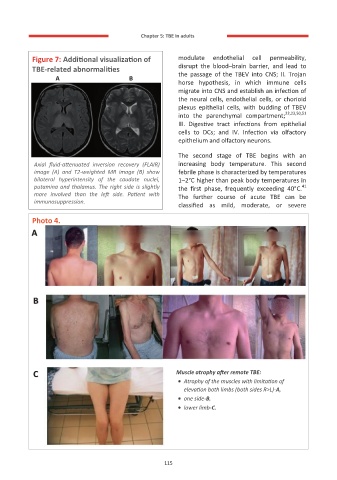
           C                                         Muscle atrophy after remote TBE:
                                                      •  Atrophy of the muscles with limitation of
                                                       elevation both limbs (both sides R>L)-A,
                                                      •  one side-B,
                                                      •  lower limb-C.


                                                  115
                                                  115

