


Page 140 - TBE_Book_V2_2019
P. 140
Chapter 7: TBE in special situations


          severe  encephalitis.  Finally,  the  patient   rheumatic diseases before initiating rituximab
          survived  with  several  months  of  reconvales-  and  can  be  recommended  if  the  clinical
                                                                    2
          cence and persistent neurological sequelae.   situation  permits.   Still,  the  resulting  protec-
                                                      tion rate remains unknown.
          Expectedly,  the  inability  to  generate  an
          antibody  response  renders  rituximab-treated   In  a  recent  report  an  immunosuppressed
          patients  susceptible  to  TBE  and  it  also   patient in Italy had persistent viremia associ-
          impedes  laboratory  diagnosis.  It  is  reported   ated to the erythrocyte fraction and shedding
          that  in  patients  under  rituximab  therapy  the   of  the  virus  in  the  urine  for  more  than  six
          antibody  response  is  deficient  for  up  to  6   weeks,  while  receiving  chemotherapy  for
          months, making vaccination of these patients   relapsing  blastic  plasmacytoid  dendritic  cell
                                                              3
          a challenge. The above case of a young patient   neoplasm.  Another dramatic case of TBE in a
          who developed life-threatening TBE one year   12-year-old patient was published by Chmelik
          after rituximab medication was stopped shows   et  al.,  where  the  immunosuppressive  treat-
          that  rituximab-induced  B-cell  response/  ment  regimen  including  dexamethasone  and
          antibody-deficiency  may  even  last  up  to  one   etoposide resulted in viral replication and fatal
                                                             4
          year.  Therefore,  with  patients  receiving   outcome.   It  has  also  been  reported  that
          rituximab, information should be stressed on   thymectomized  patients  showed  a  delayed
                                                                                      5
          the importance of protecting themselves from   humoral immune response to TBE virus.
          tick  bites  and  unpasteurized  milk.  There  are
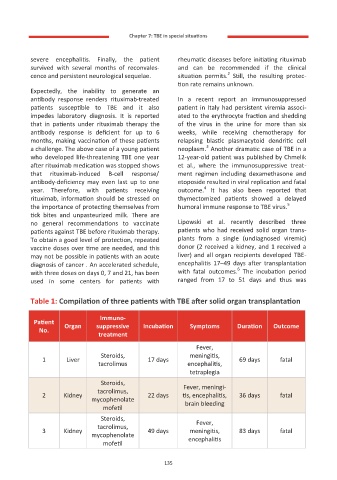
          no  general  recommendations  to  vaccinate   Lipowski  et  al.  recently  described  three
          patients against TBE before rituximab therapy.   patients  who  had  received  solid  organ  trans-
          To obtain a good level of protection, repeated   plants  from  a  single  (undiagnosed  viremic)
          vaccine doses over time are needed, and this   donor (2 received a kidney, and 1 received a
          may not be possible in patients with an acute   liver) and all organ recipients developed TBE-
          diagnosis of cancer . An accelerated schedule,   encephalitis  17–49  days  after  transplantation
                                                                       6
          with three doses on days 0, 7 and 21, has been   with  fatal  outcomes.   The  incubation  period
          used  in  some  centers  for  patients  with   ranged  from  17  to  51  days  and  thus  was


          Table 1: Compilation of three patients with TBE after solid organ transplantation

                               Immuno-
           Patient   Organ    suppressive   Incubation   Symptoms      Duration   Outcome
             No.
                              treatment

                                                           Fever,
                               Steroids,                 meningitis,
              1      Liver                   17 days                    69 days     fatal
                              tacrolimus                 encephalitis,
                                                         tetraplegia
                               Steroids,
                                                       Fever, meningi-
                              tacrolimus,
              2     Kidney                   22 days   tis, encephalitis,   36 days   fatal
                            mycophenolate
                                                        brain bleeding
                                mofetil
                               Steroids,
                                                           Fever,
                              tacrolimus,
              3     Kidney                   49 days     meningitis,    83 days     fatal
                            mycophenolate
                                                         encephalitis
                                mofetil

                                                  135
                                                  135

