


Page 143 - TBE_Book_V2_2019
P. 143
Chapter 7: TBE in special situations


          of gestation. The mother gave birth to twins at   Some  other  less  well-documented  TBE  cases
          term.  Both  infants  did  not  show  any  sero-  during pregnancy resulted in healthy neonates
          logical  evidence  or  signs  of  active  TBE   with no evidence of infection or neurological
          infection.                                  symptoms.

          In conclusion there are few reports on TBE in   These cases also show that pregnancy may be
          pregnancy.  The  two  cases  of  TBE  in  the  late   associated with a more severe course of TBE,
          second  trimester  from  2018  show  that  a   which  may  result  from  the  immunological
          diaplacental infection could not be detected.    situation  during  pregnancy,  where  there  is  a
                                                      kind of physiological immuno-suppression.
          This observation is confirmed by a case early
          in the 1960s where the infection in week 24 of
          gestation  resulted  in  a  healthy  child  with  no   Alimentary TBE
          evidence  of  TBE  or  any  neurological  symp-
          toms.
                                                      It has been known for a long time that TBE can
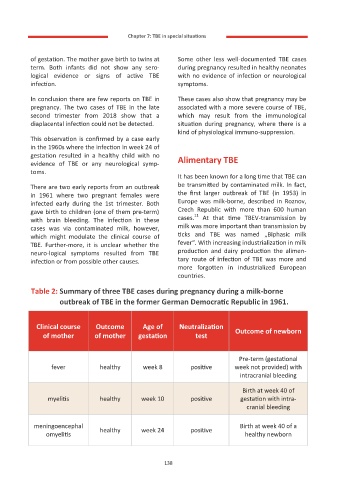
          There are two early reports from an outbreak   be transmitted by contaminated milk. In fact,
          in  1961  where  two  pregnant  females  were   the  first  larger  outbreak  of  TBE  (in  1953)  in
          infected  early  during  the  1st  trimester.  Both   Europe  was  milk-borne,  described  in  Roznov,
          gave birth to children (one of them pre-term)   Czech  Republic  with  more  than  600  human
                                                           11
          with  brain  bleeding.  The  infection  in  these   cases.   At  that  time  TBEV-transmission  by
          cases  was  via  contaminated  milk,  however,   milk was more important than transmission by
          which  might  modulate  the  clinical  course  of   ticks  and  TBE  was  named  „Biphasic  milk
          TBE.  Further-more,  it  is  unclear  whether  the   fever“. With increasing industrialization in milk
          neuro-logical  symptoms  resulted  from  TBE   production  and  dairy  production  the  alimen-
          infection or from possible other causes.    tary  route  of  infection  of  TBE  was  more  and
                                                      more  forgotten  in  industrialized  European
                                                      countries.

          Table 2: Summary of three TBE cases during pregnancy during a milk-borne
                   outbreak of TBE in the former German Democratic Republic in 1961.


            Clinical course   Outcome      Age of     Neutralization   Outcome of newborn
              of mother      of mother    gestation        test


                                                                        Pre-term (gestational
                fever          healthy     week 8        positive     week not provided) with
                                                                        intracranial bleeding

                                                                         Birth at week 40 of
               myelitis        healthy     week 10       positive       gestation with intra-
                                                                          cranial bleeding


           meningoencephal                                              Birth at week 40 of a
                               healthy     week 24       positive
               omyelitis                                                  healthy newborn


                                                  138
                                                  138

