


Page 17 - TBE_Book_V2_2019
P. 17
Chapter 1: A short history of TBE


          through Asia and the western TBEV groups to
          the west, and they might have reached central
          Europe approximately 2000 years ago. Howev-
          er, the first isolation of TBEV succeeded only
          in 1937.

          In the 1930s, a large number of people living
          in the taiga in the Far East and Soviet troops
          located  in  that  region  fell  ill  with  a  serious
          neurological  disease,  with  a  frequently  fatal
          outcome. The etiology of the disease was un-
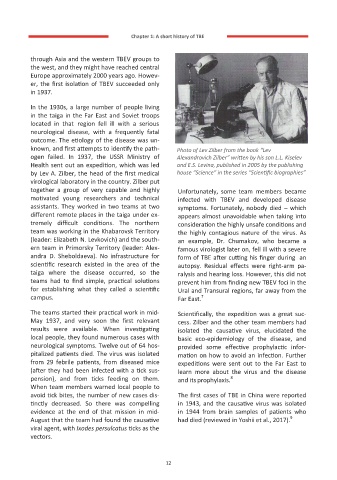
          known, and first attempts to identify the path-  Photo of Lev Zilber from the book “Lev
          ogen  failed.  In  1937,  the  USSR  Ministry  of   Alexandrovich Zilber” written by his son L.L. Kiselev
          Health sent out an expedition, which was led   and E.S. Levina, published in 2005 by the publishing
          by Lev A. Zilber, the head of the first medical   house “Science” in the series “Scientific biographies”
          virological laboratory in the country. Zilber put
          together  a  group  of  very  capable  and  highly   Unfortunately,  some  team  members  became
          motivated  young  researchers  and  technical   infected  with  TBEV  and  developed  disease
          assistants.  They worked in two teams at two   symptoms. Fortunately, nobody died  – which
          different remote places in the taiga under ex-  appears almost unavoidable when taking into
          tremely  difficult  conditions.  The  northern   consideration the highly unsafe conditions and
          team was working in the Khabarovsk Territory   the  highly  contagious  nature  of  the  virus.  As
          (leader: Elizabeth N. Levkovich) and the south-  an  example,  Dr.  Chumakov,  who  became  a
          ern team in Primorsky Territory (leader: Alex-  famous virologist later on, fell ill with a severe
          andra  D.  Sheboldaeva).  No  infrastructure  for   form of TBE after cutting his finger during  an
          scientific  research  existed  in  the  area  of  the   autopsy.  Residual  effects  were  right-arm  pa-
          taiga  where  the  disease  occurred,  so  the   ralysis and hearing loss. However, this did not
          teams  had  to  find  simple,  practical  solutions   prevent him from finding new TBEV foci in the
          for  establishing  what  they  called  a  scientific   Ural and Transural regions, far away from the
                                                             7
          campus.                                     Far East.
          The teams started their practical work in mid-  Scientifically, the expedition  was a great  suc-
          May  1937,  and  very  soon  the  first  relevant   cess. Zilber and the other team members had
          results  were  available.  When  investigating   isolated  the  causative  virus,  elucidated  the
          local people, they found numerous cases with   basic  eco-epidemiology  of  the  disease,  and
          neurological symptoms. Twelve out of 64 hos-  provided  some  effective  prophylactic  infor-
          pitalized patients died. The virus was isolated   mation on how to avoid an infection. Further
          from  29  febrile  patients,  from  diseased  mice   expeditions  were  sent  out  to  the  Far  East  to
          (after they had been infected with a tick sus-  learn  more  about  the  virus  and  the  disease
                                                                     8
          pension),  and  from  ticks  feeding  on  them.   and its prophylaxis.
          When team members warned local people to
          avoid tick bites, the number of new cases dis-  The first cases of TBE in China were reported
          tinctly  decreased.  So  there  was  compelling   in 1943, and the causative virus was isolated
          evidence  at  the  end  of  that  mission  in  mid-  in  1944  from  brain  samples  of  patients  who
                                                                                       9
          August that the team had found the causative   had died (reviewed in Yoshii et al., 2017).
          viral agent, with Ixodes persulcatus ticks as the
          vectors.


                                                  12

