


Page 18 - TBE_Book_V2_2019
P. 18
Chapter 1:  A short history of TBE


          The  discovery  of  TBE  in  Europe  started  with
          the  clinical-epidemiological  description  of  24
          cases  of  aseptic  meningitis  in  the  district  of
          Neunkirchen  (Lower  Austria)  by  Schneider  in
               4
          1931.   Although  the  outcome  was  described
          as benign, the convalescence of many patients
          was prolonged. In the early 1940s scientists of
          the Rockefeller Institute for Medical Research
          in  New  York  showed  serological  cross-
          reactions  between  hyperimmune  sera  of
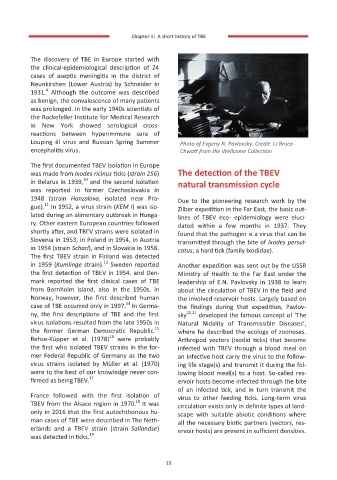
          Louping  ill  virus  and  Russian  Spring  Summer   Photo of Evgeny N. Pavlovsky. Credit: LJ Bruce-
          encephalitis virus.                         Chwatt from the Wellcome Collection

          The first documented TBEV isolation in Europe
          was made from Ixodes ricinus ticks (strain 256)   The detection of the TBEV
                          10
          in Belarus in 1939,  and the second isolation   natural transmission cycle
          was  reported  in  former  Czechoslovakia  in
          1948  (strain  Hanzalova,  isolated  near  Pra-  Due  to  the  pioneering  research  work  by  the
              11
          gue).  In 1952, a virus strain (KEM I) was iso-  Zilber expedition in the Far East, the basic out-
          lated during an alimentary outbreak in Hunga-
                                                      lines  of  TBEV  eco-  epidemiology  were  eluci-
          ry. Other eastern European countries followed   dated  within  a  few  months  in  1937.  They
          shortly after, and TBEV strains were isolated in   found that the pathogen is a virus that can be
          Slovenia in 1953, in Poland in 1954, in Austria   transmitted through the bite of Ixodes persul-
          in 1954 (strain Scharl), and in Slovakia in 1958.   catus, a hard tick (family Ixodidae).
          The first TBEV strain in Finland was detected
                                12
          in 1959 (Kumlinge strain).  Sweden reported   Another expedition was sent out by the USSR
          the first detection of TBEV in 1954, and Den-  Ministry  of  Health  to  the  Far  East  under  the
          mark  reported  the  first  clinical  cases  of  TBE   leadership of E.N. Pavlovsky  in 1938 to  learn
          from  Bornholm  Island,  also  in  the  1950s.  In   about the circulation of TBEV in the field and
          Norway,  however,  the  first  described  human   the involved reservoir hosts. Largely based on
                                      14
          case of TBE occurred only in 1997.  In Germa-  the  findings  during  that  expedition,  Pavlov-
          ny, the  first  descriptions  of  TBE  and  the  first   sky 20,21  developed the famous concept of ‘The
          virus isolations resulted from the late 1950s in   Natural  Nidality  of  Transmissible  Diseases’,
                                               15
          the  former  German  Democratic  Republic.    where he described the ecology of zoonoses.
                                 16
          Rehse-Küpper  et  al.  (1978)   were  probably   Arthropod  vectors  (ixodid  ticks)  that  become
          the first who isolated TBEV strains in the for-  infected  with  TBEV  through  a  blood  meal  on
          mer Federal Republic of Germany as the two   an infective host carry the virus to the follow-
          virus  strains  isolated  by  Müller  et  al.  (1970)   ing life stage(s) and transmit it during the fol-
          were to the best of our knowledge never con-  lowing blood meal(s) to a host. So-called res-
                           17
          firmed as being TBEV.                       ervoir hosts become infected through the bite
                                                      of  an  infected  tick,  and  in  turn  transmit  the
          France  followed  with  the  first  isolation  of   virus  to  other  feeding  ticks.  Long-term  virus
                                         18
          TBEV from the Alsace region in 1970.  It was   circulation exists only in definite types of land-
          only in 2016 that the first autochthonous hu-  scape  with  suitable  abiotic  conditions  where
          man cases of TBE were described in The Neth-
                                                      all the necessary biotic partners (vectors, res-
          erlands  and  a  TBEV  strain  (strain  Sallandse)   ervoir hosts) are present in sufficient densities.
                            19
          was detected in ticks.


                                                     13

