


Page 198 - TBE_Book_V2_2019
P. 198
Chapter 11: General epidemiology of TBE


          Ixodes  and Dermacentor.  In  at  least  2  more   During the last century a number of scientists,
          expeditions  to  study  the  transmission  of  this   especially from Russia and the Czech Republic,
          disease  (later  named  Russian  Spring  Summer   studied  in  detail  the  landscapes  that  are
          Encephalitis,  and  currently  known  as  tick-  associated  with  the  occurrence  of  TBE.
                                                                          4
                                                            3
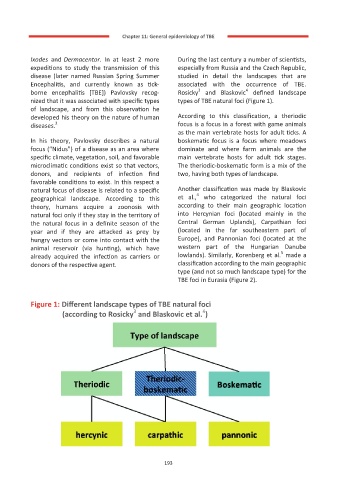
          borne  encephalitis  [TBE])  Pavlovsky  recog-  Rosicky   and  Blaskovic   defined  landscape
          nized that it was associated with specific types   types of TBE natural foci (Figure 1).
          of  landscape,  and  from  this  observation  he
          developed his theory on the nature of human   According  to  this  classification,  a  theriodic
                 2
          diseases.                                   focus is a focus in a forest with game animals
                                                      as the main vertebrate hosts for adult ticks. A
          In  his  theory,  Pavlovsky  describes  a  natural   boskematic  focus  is  a  focus  where  meadows
          focus (“Nidus”) of a disease as an area where   dominate  and  where  farm  animals  are  the
          specific climate, vegetation, soil, and favorable   main  vertebrate  hosts  for  adult  tick  stages.
          microclimatic conditions exist so that vectors,   The theriodic-boskematic form is a mix of the
          donors,  and  recipients  of  infection  find   two, having both types of landscape.
          favorable conditions to exist. In this respect a
          natural focus of disease is related to a specific   Another  classification  was  made  by  Blaskovic
                                                           4
          geographical  landscape.  According  to  this   et  al.,   who  categorized  the  natural  foci
          theory,  humans  acquire  a  zoonosis  with   according  to  their  main  geographic  location
          natural foci only if they stay in the territory of   into  Hercynian  foci  (located  mainly  in  the
          the  natural  focus  in  a  definite  season  of  the   Central  German  Uplands),  Carpathian  foci
          year  and  if  they  are  attacked  as  prey  by   (located  in  the  far  southeastern  part  of
          hungry vectors or come into contact with the   Europe),  and  Pannonian  foci  (located  at  the
          animal  reservoir  (via  hunting),  which  have   western  part  of  the  Hungarian  Danube
                                                                                    5
          already  acquired  the  infection  as  carriers  or   lowlands). Similarly, Korenberg et al.  made a
          donors of the respective agent.             classification according to the main geographic
                                                      type (and not so much landscape type) for the
                                                      TBE foci in Eurasia (Figure 2).


          Figure 1: Different landscape types of TBE natural foci
                                         3
                                                             4
                   (according to Rosicky  and Blaskovic et al. )


                                                  193
                                                  193

