


Page 244 - TBE_Book_V2_2019
P. 244
Chapter 12b


                              TBE in Belarus


                      Wilhelm Erber and Tamara Vuković Janković

          History and Current Situation

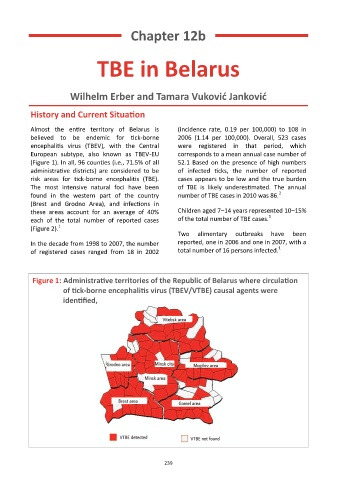
          Almost  the  entire  territory  of  Belarus  is   (incidence  rate,  0.19  per  100,000)  to  108  in
          believed  to  be  endemic  for  tick-borne   2006  (1.14  per  100,000).  Overall,  523  cases
          encephalitis  virus  (TBEV),  with  the  Central   were  registered  in  that  period,  which
          European  subtype,  also  known  as  TBEV-EU   corresponds to a mean annual case number of
          (Figure 1). In all, 96 counties (i.e., 71.5% of all   52.1 Based on the presence of high numbers
          administrative  districts)  are  considered  to  be   of  infected  ticks,  the  number  of  reported
          risk  areas  for  tick-borne  encephalitis  (TBE).   cases appears to be low and the true burden
          The  most  intensive  natural  foci  have  been   of  TBE  is  likely  underestimated.  The  annual
                                                                                    2
          found  in  the  western  part  of  the  country   number of TBE cases in 2010 was 86.
          (Brest  and  Grodno  Area),  and  infections  in
          these  areas  account  for  an  average  of  40%   Children aged 7–14 years represented 10–15%
                                                                                 1
          each  of  the  total  number  of  reported  cases   of the total number of TBE cases.
                  1
          (Figure 2).
                                                      Two  alimentary  outbreaks  have  been
          In the decade from 1998 to 2007, the number   reported, one in 2006 and one in 2007, with a
                                                                                   1
          of  registered  cases  ranged  from  18  in  2002   total number of 16 persons infected.


           Figure 1: Administrative territories of the Republic of Belarus where circulation
                    of tick-borne encephalitis virus (TBEV/VTBE) causal agents were
                    identified,


                                                  239

