


Page 286 - TBE_Book_V2_2019
P. 286
Chapter 12b: TBE in Finland


          Overview of TBE in Finland

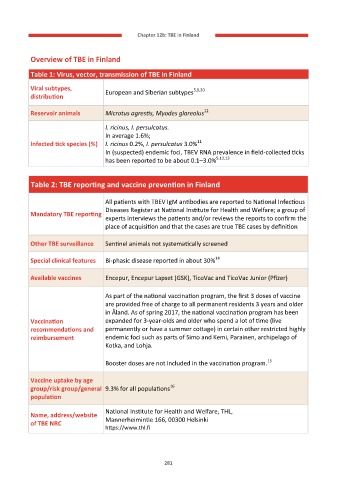
           Table 1: Virus, vector, transmission of TBE in Finland

          Viral subtypes,       European and Siberian subtypes 5,9,20
          distribution

                                                             12
          Reservoir animals     Microtus agrestis, Myodes glareolus
                                I. ricinus, I. persulcatus.
                                In average 1.6%;
                                                           11
          Infected tick species (%)  I. ricinus 0.2%, I. persulcatus 3.0%
                                In (suspected) endemic foci, TBEV RNA prevalence in field-collected ticks
                                has been reported to be about 0.1–3.0% 5,12,13


           Table 2: TBE reporting and vaccine prevention in Finland


                                All patients with TBEV IgM antibodies are reported to National Infectious
                                Diseases Register at National Institute for Health and Welfare; a group of
          Mandatory TBE reporting
                                experts interviews the patients and/or reviews the reports to confirm the
                                place of acquisition and that the cases are true TBE cases by definition

          Other TBE surveillance   Sentinel animals not systematically screened

                                                                 14
          Special clinical features   Bi-phasic disease reported in about 30%

          Available vaccines    Encepur, Encepur Lapset (GSK), TicoVac and TicoVac Junior (Pfizer)

                                As part of the national vaccination program, the first 3 doses of vaccine
                                are provided free of charge to all permanent residents 3 years and older
                                in Åland. As of spring 2017, the national vaccination program has been
          Vaccination           expanded for 3-year-olds and older who spend a lot of time (live
          recommendations and   permanently or have a summer cottage) in certain other restricted highly
          reimbursement         endemic foci such as parts of Simo and Kemi, Parainen, archipelago of
                                Kotka, and Lohja.

                                                                                15
                                Booster doses are not included in the vaccination program.

          Vaccine uptake by age
                                                   16
          group/risk group/general  9.3% for all populations
          population
                                National Institute for Health and Welfare, THL,
          Name, address/website
          of TBE NRC            Mannerheimintie 166, 00300 Helsinki
                                https://www.thl.fi


                                                  281

