


Page 292 - TBE_Book_V2_2019
P. 292
Chapter 12b: TBE in France


          In  2017  and  2018,  18  and  24  cases  were   Consuming raw milk cheese before the onset
          reported,  respectively,  by  the  3  laboratories   of symptoms was recorded for 1 patient, but
          involved  in  TBE  testing.  Except  for  the  year   without any proof that this was the source of
          2017, in 2016 and 2018 more than 80% of the   the TBEV infection.
          cases  were  autochthonous.  From  2013  to
          2018, the transmission period for TBEV is from   In  60%  of  cases,  an  initial  disease  stage  with
          April to October, with a peak in June and July   fever  and  flu-like  symptoms  occurs  prior  to
          in half of all cases.                       the  onset  of  meningitis  or  encephalitis
                                                      symptoms.  Among  those  cases,  37%  had
          From  2013  to  2017,  60%  of  the  patients   meningitis  without  any  other  neurological
                                           6
          presented  with  meningoencephalitis.   All   symptoms  and  54.3%  had  neurological  signs
          patients  were  hospitalized.  The  female-to-  associated  with  meningitis.  For  2  patients,  a
          male  ratio  was  0.4;  mean  age  was  53  years.   clinical  diagnosis  of  meningoradiculitis  was
          Also, 63% of the patients remembered a tick   established. Collected clinical data concerning
          bite during the weeks before the beginning of   TBE  confirmed  cases  in  2018  are  currently
          symptoms that led to TBE diagnosis.         under analysis.


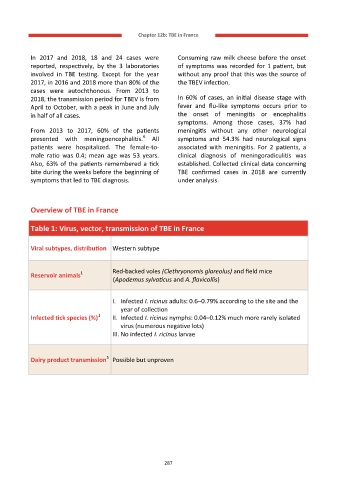
          Overview of TBE in France


           Table 1: Virus, vector, transmission of TBE in France

          Viral subtypes, distribution  Western subtype


                                  Red-backed voles (Clethryonomis glareolus) and field mice
                         1
          Reservoir animals
                                  (Apodemus sylvaticus and A. flavicollis)
                                  I.  Infected I. ricinus adults: 0.6–0.79% according to the site and the
                                     year of collection
                              1
          Infected tick species (%)    II.  Infected I. ricinus nymphs: 0.04–0.12% much more rarely isolated
                                     virus (numerous negative lots)
                                  III. No infected I. ricinus larvae


                                 5
          Dairy product transmission   Possible but unproven


                                                  287

