


Page 330 - TBE_Book_V2_2019
P. 330
Chapter 12b: TBE in Latvia


          Vaccination is mandatory for employees with   Currently  used  vaccines  in  Latvia  are  FSME-
          high  risk  of  occupational  exposure  such  as   Immun®  (TicoVac,  used  since  1995)  and
          forest  workers,  military  personnel,  and  lab   Encepur® (since 2001 for adults and 2002 for
          workers  and  is  paid  by  the  employer.  For   children). FSME-IMMUN® is the most common
          other  residents  of  Latvia  and  travellers   used  TBE  vaccine  in  Latvia,  having  up  to  an
          vaccination is also strongly recommended, but   86%  market  share  in  those  vaccinees  who
          not  reimbursed,  but  most  of  the  private   received at least one dose of TBE vaccine and
                                                                                          17
          insurance  companies  covers  TBE  vaccine   knew   which   brand   they   received.
          expenses. 13,14    Because   of   National   Nevertheless,  the  number  of  vaccination
          Immunization  Program,  TBE  vaccination    doses  sold  annually  should  be  cautiously
          coverage  in  children  reached  up  to  77%  in   correlated  to  percentage  of  vaccinated
          highly  endemic  areas  and  22%  nationwide,   population,  because  exact  vaccine  usage  at
          reducing  proportion  of  TBE  cases  among   individual level remains unclear and cannot be
                                               15
          children from 12.5% in 2001 to 3.6% in 2010    equalized with the sales amount.
          and  2016.  For  whole  population  vaccination
                             15
          rate  was  39%  in  2009   and  increased  up  to
                      16
          52.5% in 2015.
          Overview of TBE in Latvia

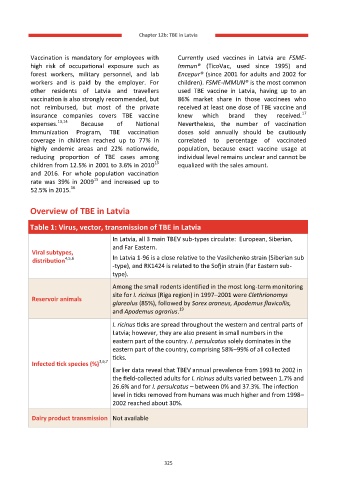
          Table 1: Virus, vector, transmission of TBE in Latvia

                                  In Latvia, all 3 main TBEV sub-types circulate:  European, Siberian,
                                  and Far Eastern.
          Viral subtypes,
           distribution 4,5,6     In Latvia 1-96 is a close relative to the Vasilchenko strain (Siberian sub
                                  -type), and RK1424 is related to the Sofjin strain (Far Eastern sub-
                                  type).
                                  Among the small rodents identified in the most long-term monitoring
                                  site for I. ricinus (Riga region) in 1997–2001 were Clethrionomys
          Reservoir animals
                                  glareolus (85%), followed by Sorex araneus, Apodemus flavicollis,
                                                      19
                                  and Apodemus agrarius.
                                  I. ricinus ticks are spread throughout the western and central parts of
                                  Latvia; however, they are also present in small numbers in the
                                  eastern part of the country. I. persulcatus solely dominates in the
                                  eastern part of the country, comprising 58%–99% of all collected
                                  ticks.
          Infected tick species (%) 3,6,7
                                  Earlier data reveal that TBEV annual prevalence from 1993 to 2002 in
                                  the field-collected adults for I. ricinus adults varied between 1.7% and
                                  26.6% and for I. persulcatus – between 0% and 37.3%. The infection
                                  level in ticks removed from humans was much higher and from 1998–
                                  2002 reached about 30%.

          Dairy product transmission  Not available


                                                  325

