


Page 379 - TBE_Book_V2_2019
P. 379
Chapter 12b: TBE in Russia


               19
          group.   In  1950-1960  second  generation  of   awareness  and  absence  of  an  NIP  –  regions
          TBE  vaccine  based  on  chicken  embryotic  cell   are  purchasing  vaccine  doses  on  their  own
          culture  for  virus  reproduction  was  establish-  according to the availability of a local budget
            20
          ed .  The  vaccine  was  “upgraded”  in  1961-  (Figure 3). 16,23,24
          1966,  tested  in  Western  Siberia  with  good
          field  effectiveness.  In  the  1980s  further  im-  Nonspecific prevention is possible for all tick-
          provement in reactogenicity were achieved by   borne  infections.  Acaricidal  treatment  of
          a purified, lyophilized third generation vaccine   endemic territories with special chemicals like
          and  this  is  currently  licensed  and  used  in   cipermetrin  25%  or  analogues  is  regarded  to
          Russia. 21,22                               be  the  main  measure  nowadays.  Compared
                                                      with 2011, these measures more than doubled
          In 2017 in Russia primary and booster series of   and in 2016 over 17,600,000 m2 of the most
          TBE vaccines were administered to 3.1 million   populated and actively used areas (i.e. parks,
          persons.  In  the  last  6  years,  the  planned   camps and recreation zones, hospital, hotels,
          annual immunization rates have not exceeded   school  and  kindergarten  territories)  were
                                                                           23
          3.3 million persons per year, which is about 4   treated this way in the RF.
          times lower than required due to insufficient


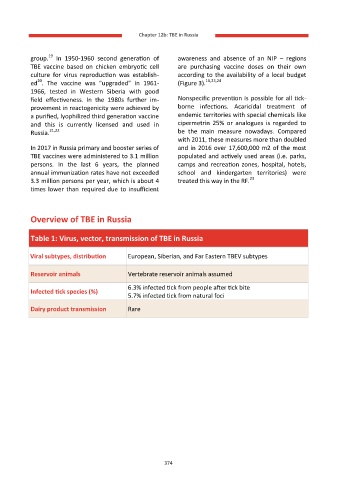
          Overview of TBE in Russia

           Table 1: Virus, vector, transmission of TBE in Russia


          Viral subtypes, distribution   European, Siberian, and Far Eastern TBEV subtypes

          Reservoir animals            Vertebrate reservoir animals assumed
                                       6.3% infected tick from people after tick bite
          Infected tick species (%)
                                       5.7% infected tick from natural foci
          Dairy product transmission   Rare


                                                  374

