


Page 70 - TBE_Book_V2_2019
P. 70
Chapter 3: Transmission /Natural cycle


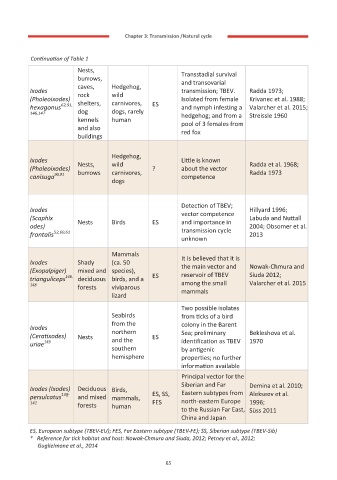
          Continuation of Table 1
                        Nests,                         Transstadial survival
                        burrows,
                                                       and transovarial
                        caves,    Hedgehog,
          Ixodes                                       transmission; TBEV.    Radda 1973;
                        rock      wild
          (Pholeoixodes)                               Isolated from female   Krivanec et al. 1988;
                        shelters,   carnivores,   ES   and nymph infesting a  Valarcher et al. 2015;
                        dog       dogs, rarely
                                                       hedgehog; and from a  Streissle 1960
                        kennels   human
                                                       pool of 3 females from
                        and also
                                                       red fox
                        buildings
                                  Hedgehog,
          Ixodes        Nests,    wild                 Little is known     Radda et al. 1968;
          (Pholeoixodes)                      ?        about the vector
                 90,91  burrows   carnivores,                              Radda 1973
          canisuga                                     competence
                                  dogs

                                                       Detection of TBEV;
          Ixodes                                       vector competence   Hillyard 1996;
          (Scaphix                                                         Labuda and Nuttall
                        Nests     Birds       ES       and importance in
          odes)                                                            2004; Obsomer et al.
                                                       transmission cycle
                                                                           2013
                                                       unknown
                                  Mammals
                                                       It is believed that it is
          Ixodes        Shady     (ca. 50              the main vector and   Nowak-Chmura and
          (Exopalpiger)   mixed and  species),         reservoir of TBEV   Siuda 2012;
          trianguliceps 146,  deciduous  birds, and a   ES
          148                                          among the small     Valarcher et al. 2015
                        forests   viviparous
                                                       mammals
                                  lizard
                                                       Two possible isolates
                                  Seabirds             from ticks of a bird
                                  from the             colony in the Barent
          Ixodes
                                  northern             Sea; preliminary    Bekleshova et al.
          (Ceratixodes)   Nests   and the     ES
          uriae 149                                    identification as TBEV   1970
                                  southern             by antigenic
                                  hemisphere           properties; no further
                                                       information available
                                                       Principal vector for the
                                                       Siberian and Far    Demina et al. 2010;
          Ixodes (Ixodes)   Deciduous  Birds,          Eastern subtypes from  Alekseev et al.
          persulcatus   and mixed  mammals,   ES, SS,   north-eastern Europe
                        forests   human       FES                          1996;
                                                       to the Russian Far East,  Süss 2011
                                                       China and Japan

          ES, European subtype (TBEV-EU); FES, Far Eastern subtype (TBEV-FE); SS, Siberian subtype (TBEV-Sib)
          *   Reference for tick habitat and host: Nowak-Chmura and Siuda, 2012; Petney et al., 2012;
            Guglielmone et al., 2014

                                                  65

