


Page 71 - TBE_Book_V2_2019
P. 71
Chapter 3: Transmission / Natural cycle


          Adult  females  have  4  pairs  of  legs,  and   other shelters used by their hosts), and tend
          spiracles, a genital aperture, and porose areas   to  be  more  host-specific. 7,14   Many  Ixodes
                                                                         14
          on  the  dorsal  surface  of  the  basis  capituli   species  are  nidicolous.   The  main  vectors  of
          (Figures 2a and 2b). Males have 4 pairs of legs,   TBEV, I. ricinus and I. persulcatus are exophilic
          the  scutum  covers  the  entire  dorsal  surface,   and exceptional both in terms of the variety of
          and  hard  sclerotized  plates  cover  the  ventral   hosts  they  use  as  well  as  the  habitats  they
                                                            18
          body surface of some species (Figures 2c and   occupy.
          2d). Ixodes males have the whole ventral view
          covered with a total of 7 ventral plates.    Host-finding behavior

          Types of hard ticks                         Ixodid  ticks’  host-seeking  behavior  is  under
                                                      the  control  of  different  abiotic  factors  that
          Ixodid ticks fall into 2 behavioral groups with   differ  according  to  the  region.  In  temperate
          respect to their habitat selection. Exophilic or   and  sub-polar  regions,  seasonal  activity  is
          non-nidicolous  ixodid  ticks  occur  in  the  open   mainly  regulated  by  ambient  temperature,
          environment  and  are  associated,  depending   changing  photoperiod,  and  incident  solar
          on  the  species,  with  forests,  savannahs,   energy,  and  in  the  more  temperate  regions,
          second-growth  areas  of  scrub  and  brush,   tick  activity  is  often  controlled  by  saturation
          grassy meadows, semi-desert, or desert areas.   deficit  and  relative  humidity,  with  long-term
                                                                                          14
          Such  species  are  usually  not  host-specific.   dry  conditions  being  adverse  for  survival.
          Nidicolous or endophilic ixodid ticks live in or   Those species involved in the transmission of
          near  the nests of their hosts, are  adapted to   TBEV tend to quest passively or ambush their
          highly  specialized  environments  (crevices  or   hosts  by  climbing  onto  weeds,  grasses,  or

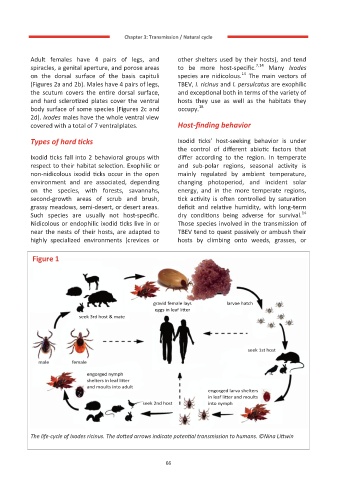
           Figure 1


          The life-cycle of Ixodes ricinus. The dotted arrows indicate potential transmission to humans. ©Nina Littwin


                                                  66

