Page 322 - TBE_Book_V2_2019
P. 322

Chapter 12b: TBE in Kazakhstan


          Overview of TBE in Kazakhstan

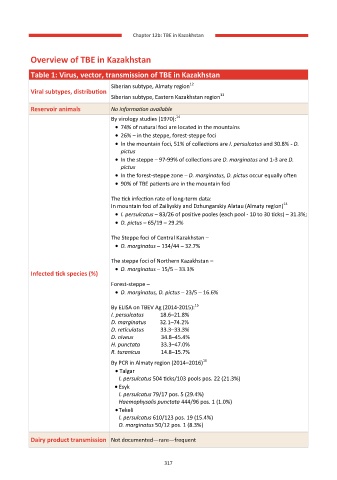
           Table 1: Virus, vector, transmission of TBE in Kazakhstan
                                                         12
                                  Siberian subtype, Almaty region
          Viral subtypes, distribution                            13
                                  Siberian subtype, Eastern Kazakhstan region
          Reservoir animals       No information available
                                  By virology studies (1970): 14
                                    74% of natural foci are located in the mountains
                                    26% – in the steppe, forest-steppe foci
                                    In the mountain foci, 51% of collections are I. persulcatus and 30.8% - D.
                                     pictus
                                    In the steppe – 97-99% of collections are D. marginatus and 1-3 are D.
                                     pictus
                                    In the forest-steppe zone – D. marginatus, D. pictus occur equally often
                                    90% of TBE patients are in the mountain foci

                                  The tick infection rate of long-term data:
                                  In mountain foci of Zailiyskiy and Dzhungarskiy Alatau (Almaty region) 14
                                    I. persulcatus – 83/26 of positive pooles (each pool - 10 to 30 ticks) – 31.3%;
                                    D. pictus – 65/19 – 29.2%

                                  The Steppe foci of Central Kazakhstan –
                                    D. marginatus – 134/44 – 32.7%

                                  The steppe foci of Northern Kazakhstan –
                                    D. marginatus – 15/5 – 33.3%
          Infected tick species (%)

                                  Forest-steppe –
                                    D. marginatus, D. pictus – 23/5 – 16.6%

                                                           15
                                  By ELISA on TBEV Ag (2014-2015):
                                  I. persulcatus            18.6–21.8%
                                  D. marginatus          32.1–74.2%
                                  D. reticulatus            33.3–33.3%
                                  D. niveus                    34.8–45.4%
                                  H. punctata               33.3–47.0%
                                  R. turanicus               14.8–15.7%

                                                             16
                                  By PCR in Almaty region (2014–2016)
                                    Talgar
                                    I. persulcatus 504 ticks/103 pools pos. 22 (21.3%)
                                    Esyk
                                    I. persulcatus 79/17 pos. 5 (29.4%)
                                    Haemophysalis punctata 444/96 pos. 1 (1.0%)
                                    Tekeli
                                    I. persulcatus 610/123 pos. 19 (15.4%)
                                    D. marginatus 50/12 pos. 1 (8.3%)

          Dairy product transmission  Not documented—rare—frequent


                                                  317
   317   318   319   320   321   322   323   324   325   326   327