


Page 417 - TBE_Book_V2_2019
P. 417
Chapter 12b: TBE in Sweden


          known  TBEV-endemic  region,  Torö  island,   ii)  The roe deer population gradually declined
          southeast of Stockholm, the TBEV prevalence   after  its  peak  in  the  late  1980s  and  early
          was 0.51% in nymphs and 4.48% in adult ticks.   1990s.
                                                      iii) During  the  decline  of  the  roe  deer
          In a review of the ecology and epidemiology of
                                                        population, a gradually larger proportion of
          TBE  in  Sweden,  Jaenson  and  colleagues
                                                        the tick larvae and nymphs probably fed on
          analyzed  the  possible  reasons  behind  the   small  mammals,  which  are  reservoir-
          gradually  increasing  incidence  of  human  TBE   competent  hosts  for  TBEV.  Consequently,
                               15
          during the last 20 years.  The authors made
                                                        since the mid-1990s, a larger proportion of
          the following conclusions:
                                                        the  tick  population  became  infected  with
          i)  Due to a large roe deer population during   TBEV.
             the  1980s  and  1990s,  the  Swedish  tick   iv)  Climate  change  and  weather  events
             population gradually increased. At the turn   associated  with  higher  temperatures
             of  the  century,  the  tick  population  in
                                                        further influenced the infection prevalence
             Sweden  was  probably  larger  than  ever.
                                                        in  the  tick  population  and  therefore  also

                                                        the annual incidence in humans.
          Overview of TBE in Sweden

           Table 1: Virus, vector, transmission of TBE in Sweden

                                    Only western/European TBEV (TBEV-EU), southern part of the
          Viral subtypes, distribution     1-6
                                    country
          Reservoir animals         Not documented

                                                         14
          Infected tick species (%)   I. ricinus, 0.23% to 4.48%
          Dairy product transmission   Not documented


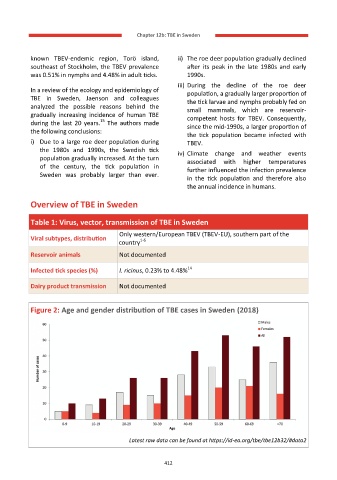
          Figure 2: Age and gender distribution of TBE cases in Sweden (2018)


                                       Latest raw data can be found at https://id-ea.org/tbe/tbe12b32/#data2


                                                  412

