


Page 92 - TBE_Book_V2_2019
P. 92
Chapter 4


                     Pathogenesis of TBE


                      with a focus on molecular mechanisms


                            Andrea Kröger and Anna K. Överby
          Key Points

           •  In this chapter we describe the pathogenesis of tick-borne encephalitis virus (TBEV).

           •  To cause infection, TBEV needs to cross three different barriers; the physical, the innate and
             adaptive, and the blood-brain barrier.
           •  The trigger of innate immune and adaptive immune responses, by TBEV is necessary to clear the
             infection.
           •  TBEV employs strategies to evade the innate immune response.

           •  Tools to study TBEV pathogenicity such as mouse knock-out models and reverse genetics are also
             discussed.


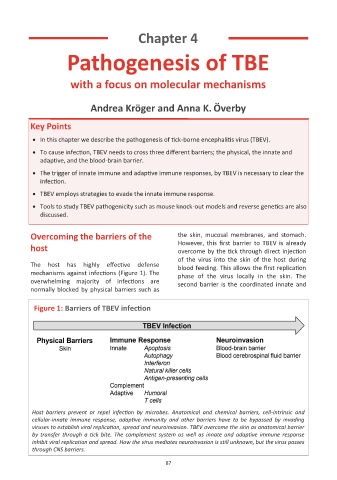
          Overcoming the barriers of the              the  skin,  mucosal  membranes,  and  stomach.
                                                      However,  this  first  barrier  to  TBEV  is  already
          host                                        overcome by the tick through direct injection
                                                      of  the  virus  into  the  skin  of  the  host  during
          The  host  has  highly  effective  defense
                                                      blood feeding. This allows the first replication
          mechanisms against infections (Figure 1). The   phase  of  the  virus  locally  in  the  skin.  The
          overwhelming  majority  of  infections  are   second  barrier  is  the  coordinated  innate  and
          normally blocked by physical barriers such as


            Figure 1: Barriers of TBEV infection


           Host  barriers  prevent  or  repel  infection  by  microbes.  Anatomical  and  chemical  barriers,  cell-intrinsic  and
           cellular-innate  immune  response,  adaptive  immunity  and  other  barriers  have  to  be  bypassed  by  invading
           viruses to establish viral replication, spread and neuroinvasion. TBEV overcome the skin as anatomical barrier
           by  transfer  through  a  tick  bite. The  complement  system  as  well  as  innate and  adaptive  immune  response
           inhibit viral replication and spread. How the virus mediates neuroinvasion is still unknown, but the virus passes
           through CNS barriers.

                                                  87

