


Page 25 - TBE_Book_V2_2019
P. 25
Chapter 2a: Virology


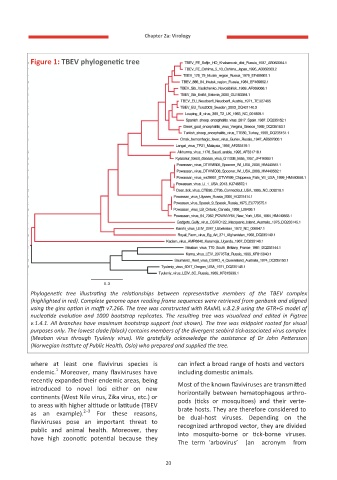
          Figure 1: TBEV phylogenetic tree


          Phylogenetic  tree  illustrating  the  relationships  between  representative  members  of  the  TBEV  complex
          (highlighted in red). Complete genome open reading frame sequences were retrieved from genbank and aligned
          using the gins option in mafft v7.266. The tree was constructed with RAxML v.8.2.9 using the GTR+G model of
          nucleotide  evolution  and  1000  bootstrap  replicates.  The  resulting  tree  was  visualized  and  edited  in  Figtree
          v.1.4.1. All branches have maximum bootstrap support (not shown). The tree was midpoint rooted for visual
          purposes only. The lowest clade (black) contains members of the divergent seabird tick-associated virus complex
          (Meaban  virus  through  Tyuleniy  virus).  We  gratefully  acknowledge  the  assistance  of  Dr  John  Pettersson
          (Norwegian Institute of Public Health, Oslo) who prepared and supplied the tree.


          where  at  least  one  flavivirus  species  is   can infect a broad range of hosts and vectors
                  1
          endemic.   Moreover,  many  flaviviruses  have   including domestic animals.
          recently expanded their endemic areas, being   Most of the known flaviviruses are transmitted
          introduced  to  novel  loci  either  on  new   horizontally  between  hematophagous  arthro-
          continents (West Nile virus, Zika virus, etc.) or
                                                      pods  (ticks  or  mosquitoes)  and  their  verte-
          to areas with higher altitude or latitude (TBEV   brate hosts. They are therefore considered to
                          2–3
          as  an  example).   For  these  reasons,
                                                      be  dual-host  viruses.  Depending  on  the
          flaviviruses  pose  an  important  threat  to   recognized arthropod vector, they are divided
          public  and  animal  health.  Moreover,  they   into  mosquito-borne  or  tick-borne  viruses.
          have  high  zoonotic  potential  because  they
                                                      The  term  ‘arbovirus’    (an    acronym    from

                                                     20

