


Page 26 - TBE_Book_V2_2019
P. 26
Chapter 2a: Virology


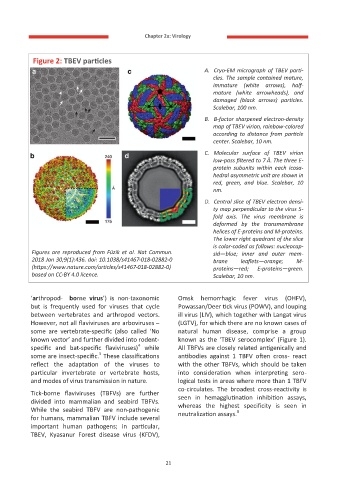
           Figure 2: TBEV particles
                                                              A.  Cryo-EM micrograph of TBEV parti-
                                                                cles. The sample contained mature,
                                                                immature  (white  arrows),  half-
                                                                mature  (white  arrowheads),  and
                                                                damaged  (black  arrows)  particles.
                                                                Scalebar, 100 nm.

                                                              B.  B-factor sharpened electron-density
                                                                map of TBEV virion, rainbow-colored
                                                                according  to  distance  from  particle
                                                                center. Scalebar, 10 nm.
                                                              C.  Molecular  surface  of  TBEV  virion
                                                                low-pass filtered to 7 Å. The three E-
                                                                protein  subunits  within  each  icosa-
                                                                hedral asymmetric unit are shown in
                                                                red,  green,  and  blue.  Scalebar,  10
                                                                nm.
                                                              D.  Central slice of TBEV electron densi-
                                                                ty map perpendicular to the virus 5-
                                                                fold  axis.  The  virus  membrane  is
                                                                deformed  by  the  transmembrane
                                                                helices of E-proteins and M-proteins.
                                                                The lower right quadrant of the slice
                                                                is color-coded as follows: nucleocap-
          Figures are reproduced from Füzik et al. Nat Commun.   sid—blue;  inner  and  outer  mem-
          2018 Jan 30;9(1):436. doi: 10.1038/s41467-018-02882-0   brane   leaflets—orange;   M-
          (https://www.nature.com/articles/s41467-018-02882-0)   proteins—red;   E-proteins—green.
          based on CC-BY 4.0 licence.                           Scalebar, 10 nm.


          ‘arthropod-    borne  virus’)  is  non-taxonomic   Omsk  hemorrhagic  fever  virus  (OHFV),
          but  is  frequently  used  for  viruses  that  cycle   Powassan/Deer tick virus (POWV), and louping
          between  vertebrates  and  arthropod  vectors.   ill virus (LIV), which together with Langat virus
          However, not all flaviviruses are arboviruses –   (LGTV), for which there are no known cases of
          some  are  vertebrate-specific  (also  called  ‘No   natural  human  disease,  comprise  a  group
          known vector’ and further divided into rodent-  known  as  the  ‘TBEV  serocomplex’  (Figure  1).
                                          4
          specific  and  bat-specific  flaviviruses)   while   All TBFVs are closely related antigenically and
                              5
          some are insect-specific.  These classifications   antibodies  against  1  TBFV  often  cross-  react
          reflect  the  adaptation  of  the  viruses  to   with the other TBFVs, which should be taken
          particular  invertebrate  or  vertebrate  hosts,   into  consideration  when  interpreting  sero-
          and modes of virus transmission in nature.   logical tests in areas where more than 1 TBFV
                                                      co-circulates.  The  broadest  cross-reactivity  is
          Tick-borne  flaviviruses  (TBFVs)  are  further   seen  in  hemagglutination  inhibition  assays,
          divided  into  mammalian  and  seabird  TBFVs.   whereas  the  highest  specificity  is  seen  in
          While  the  seabird  TBFV  are  non-pathogenic               6
                                                      neutralization assays.
          for humans, mammalian TBFV include several
          important  human  pathogens;  in  particular,

          TBEV,  Kyasanur  Forest  disease  virus  (KFDV),


                                                     21

