


Page 28 - TBE_Book_V2_2019
P. 28
Chapter 2a: Virology


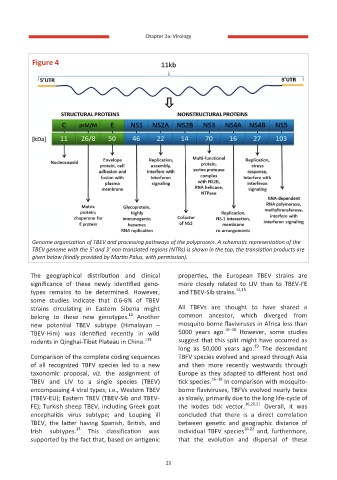
           Figure 4


           Genome organization of TBEV and processing pathways of the polyprotein. A schematic representation of the
           TBEV genome with the 5′ and 3′ non-translated regions (NTRs) is shown in the top; the translation products are
           given below (kindly provided by Martin Palus, with permission).

          The  geographical  distribution  and  clinical   properties,  the  European  TBEV  strains  are
          significance  of  these  newly  identified  geno-  more  closely  related  to  LIV  than  to  TBEV-FE
          types  remains  to  be  determined.  However,   and TBEV-Sib strains. 14,15
          some  studies  indicate  that  0.6-6%  of  TBEV
          strains  circulating  in  Eastern  Siberia  might   All  TBFVs  are  thought  to  have  shared  a
                                       12
          belong  to  these  new  genotypes.   Another   common  ancestor,  which  diverged  from
          new  potential  TBEV  subtype  (Himalayan  –   mosquito-borne flaviviruses in Africa less than
                                                                    16–18
          TBEV-Him)  was  identified  recently  in  wild   5000  years  ago.    However,  some  studies
          rodents in Qinghai-Tibet Plateau in China. 118    suggest that this split might have occurred as
                                                                            19
                                                      long  as  50,000  years  ago.   The  descendant
          Comparison of the complete coding sequences   TBFV species evolved and spread through Asia
          of  all  recognized  TBFV  species  led  to  a  new   and  then  more  recently  westwards  through
          taxonomic  proposal,  viz.  the  assignment  of   Europe as they adapted to different host and
          TBEV  and  LIV  to  a  single  species  (TBEV)   tick species. 16–18  In comparison with mosquito-
          encompassing 4 viral types; i.e., Western TBEV   borne flaviviruses, TBFVs evolved nearly twice
          (TBEV-EU); Eastern TBEV (TBEV-Sib and TBEV-  as slowly, primarily due to the long life-cycle of
          FE); Turkish sheep TBEV, including Greek goat   the  Ixodes  tick  vector. 16,20,21   Overall,  it  was
          encephalitis  virus  subtype;  and  Louping  ill   concluded  that  there  is  a  direct  correlation
          TBEV,  the  latter  having  Spanish,  British,  and   between  genetic  and  geographic  distance  of
                        13
          Irish  subtypes.   This  classification  was   individual  TBFV  species 16,22   and,  furthermore,
          supported by the fact that, based on antigenic   that  the  evolution  and  dispersal  of  these


                                                     23

