


Page 27 - TBE_Book_V2_2019
P. 27
Chapter 2a: Virology


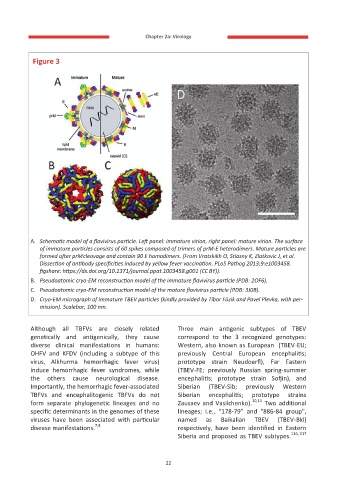
           Figure 3


          A.  Schematic model of a flavivirus particle. Left panel: immature virion, right panel: mature virion. The surface
             of immature particles consists of 60 spikes composed of trimers of prM-E heterodimers. Mature particles are
             formed after prM cleavage and contain 90 E homodimers. (From Vratskikh O, Stiasny K, Zlatkovic J, et al.
             Dissection of antibody specificities induced by yellow fever vaccination. PLoS Pathog 2013;9:e1003458.
             figshare: https://dx.doi.org/10.1371/journal.ppat.1003458.g001 (CC BY)).
          B.  Pseudoatomic cryo-EM reconstruction model of the immature flavivirus particle (PDB: 2OF6).
          C.  Pseudoatomic cryo-EM reconstruction model of the mature flavivirus particle (PDB: 3J0B).
          D.  Cryo-EM micrograph of immature TBEV particles (kindly provided by Tibor Füzik and Pavel Plevka, with per-
             mission). Scalebar, 100 nm.


          Although  all  TBFVs  are  closely  related   Three  main  antigenic  subtypes  of  TBEV
          genetically  and  antigenically,  they  cause   correspond  to  the  3  recognized  genotypes:
          diverse  clinical  manifestations  in  humans:   Western, also known as European  (TBEV-EU;
          OHFV  and  KFDV  (including  a  subtype  of  this   previously  Central  European  encephalitis;
          virus,  Alkhurma  hemorrhagic  fever  virus)   prototype  strain  Neudoerfl),  Far  Eastern
          induce  hemorrhagic  fever  syndromes,  while   (TBEV-FE;  previously  Russian  spring-summer
          the  others  cause  neurological  disease.   encephalitis;  prototype  strain  Sofjin),  and
          Importantly, the hemorrhagic fever-associated   Siberian   (TBEV-Sib;   previously   Western
          TBFVs  and  encephalitogenic  TBFVs  do  not   Siberian   encephalitis;   prototype   strains
          form  separate  phylogenetic  lineages  and  no   Zausaev  and  Vasilchenko). 10,11   Two  additional
          specific determinants in the genomes of these   lineages;  i.e.,  “178-79”  and  “886-84  group”,
          viruses  have  been  associated  with  particular   named   as   Baikalian   TBEV   (TBEV-Bkl)
                             7,8
          disease manifestations.                     respectively,  have  been  identified  in  Eastern
                                                      Siberia and proposed as TBEV subtypes. 116, 117


                                                     22

