


Page 50 - TBE_Book_V2_2019
P. 50
Chapter 2b: The molecular and antigenic structure of TBEV


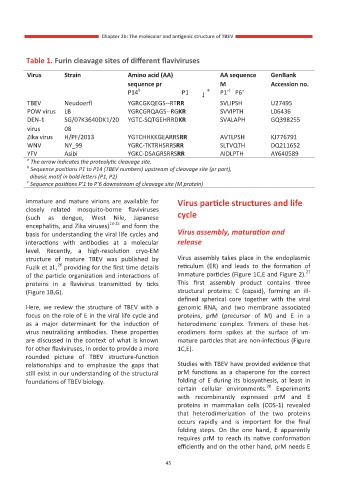
         Table 1. Furin cleavage sites of different flaviviruses

         Virus      Strain             Amino acid (AA)             AA sequence   GenBank
                                       sequence pr                M              Accession no.
                                                                     c
                                          b
                                       P14                            P1   a   P1‘    P6‘
         TBEV       Neudoerfl          YGRCGKQEGS--RTRR           SVLIPSH        U27495
         POW virus   LB                YGRCGRQAGS--RGKR           SVVIPTH        L06436
         DEN-1      SG/07K3640DK1/20   YGTC-SQTGEHRRDKR           SVALAPH        GQ398255
         virus      08
         Zika virus   H/PF/2013        YGTCHHKKGEARRSRR           AVTLPSH        KJ776791
         WNV        NY_99              YGRC-TKTRHSRRSRR           SLTVQTH        DQ211652
         YFV        Asibi              YGKC-DSAGRSRRSRR           AIDLPTH        AY640589
         a
           The arrow indicates the proteolytic cleavage site.
         b
           Sequence positions P1 to P14 (TBEV numbers) upstream of cleavage site (pr part),
           dibasic motif in bold letters (P1, P2)
         c
           Sequence positions P’1 to P’6 downstream of cleavage site (M protein)
         immature  and  mature  virions  are  available  for   Virus particle structures and life
         closely  related  mosquito-borne  flaviviruses
         (such  as  dengue,  West  Nile,  Japanese    cycle
         encephalitis, and Zika viruses) 13-25  and form the
         basis for understanding the viral life cycles and   Virus assembly, maturation and
         interactions  with  antibodies  at  a  molecular   release
         level.  Recently,  a  high-resolution  cryo-EM
         structure  of  mature  TBEV  was  published  by   Virus  assembly  takes  place  in  the  endoplasmic
                  26
         Fuzik et al.,  providing for the first time details   reticulum  (ER)  and  leads  to  the  formation  of
                                                                                            27
         of the particle organization and interactions of   immature particles (Figure 1C,E and Figure 2).
         proteins  in  a  flavivirus  transmitted  by  ticks   This  first  assembly  product  contains  three
         (Figure 1B,G).                               structural  proteins:  C  (capsid),  forming  an  ill-
                                                      defined  spherical  core  together  with  the  viral
         Here,  we  review  the  structure  of  TBEV  with  a   genomic  RNA,  and  two  membrane  associated
         focus on the role of E in the viral life cycle and   proteins,  prM  (precursor  of  M)  and  E  in  a
         as  a  major  determinant  for  the  induction  of   heterodimeric  complex.  Trimers  of  these  het-
         virus  neutralizing  antibodies.  These  properties   erodimers  form  spikes  at  the  surface  of  im-
         are discussed in the context of  what is known   mature particles that are non-infectious (Figure
         for other flaviviruses, in order to provide a more   1C,E).
         rounded  picture  of  TBEV  structure-function
         relationships  and  to  emphasize  the  gaps  that   Studies with TBEV have provided evidence that
         still exist in our understanding of the structural   prM  functions  as  a  chaperone  for  the  correct
         foundations of TBEV biology.                 folding  of  E  during  its  biosynthesis,  at  least  in
                                                                                28
                                                      certain  cellular  environments.   Experiments
                                                      with  recombinantly  expressed  prM  and  E
                                                      proteins  in  mammalian  cells  (COS-1)  revealed
                                                      that  heterodimerization  of  the  two  proteins
                                                      occurs  rapidly  and  is  important  for  the  final
                                                      folding  steps.  On  the  one  hand,  E  apparently
                                                      requires  prM  to  reach  its  native  conformation
                                                      efficiently and on the other hand, prM needs E

                                                  45

